How to Type 被 in Chinese Messages
MandarinReps
10/17/2026
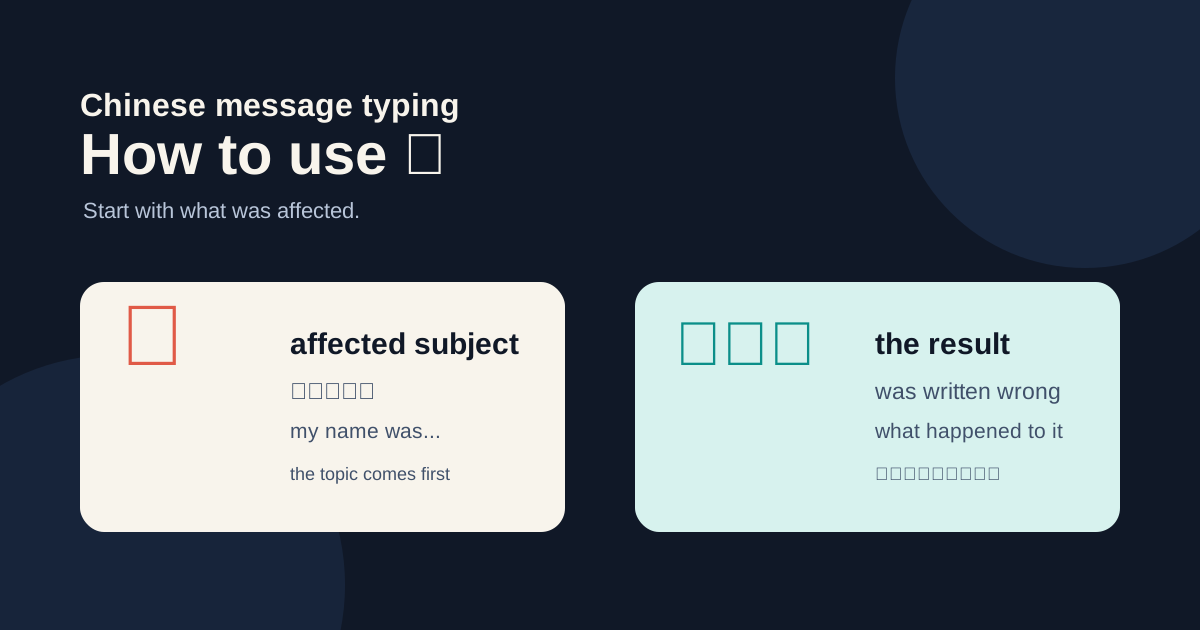
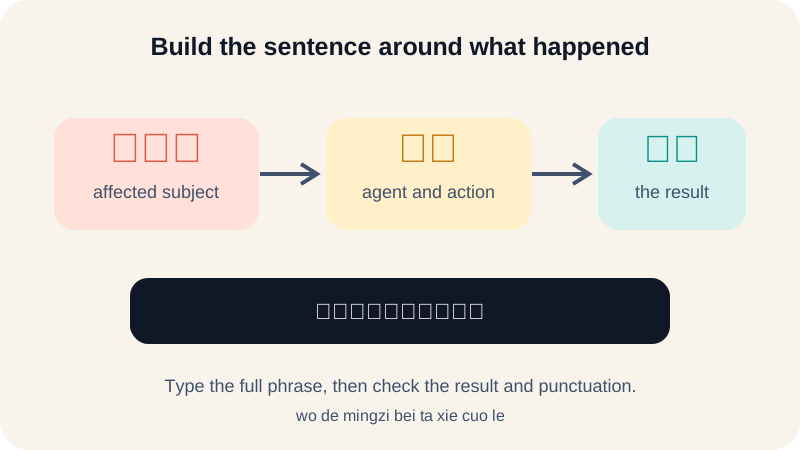
Use 被 (bèi) when the message puts an affected person or thing first and explains what happened to it. The useful learner pattern is affected subject + 被 + agent + verb + result: 我的手机被他拿走了。 (My phone was taken away by him.) You can omit the agent when it is unknown or unimportant: 我的手机被拿走了。 (My phone was taken away.)
被 is useful for messages about a file being deleted, a name being written incorrectly, a message being seen, or a plan being changed. It does not mean English "was" by itself. The sentence needs an event that affects the subject. This guide gives HSK 2 to 4 learners a practical way to type passive messages and choose the right result phrase.
The short answer: show what happened to the subject
| Message job | Useful learner pattern | Example | Meaning |
|---|---|---|---|
| Name the affected thing | 被 + agent + verb | 文件被他删了。 | He deleted the file. |
| Omit an unknown agent | 被 + verb + result | 文件被删掉了。 | The file was deleted. |
| Report a wrong detail | 被 + verb + 错 | 我的名字被写错了。 | My name was written incorrectly. |
| Report something seen | 被 + verb + 到 | 消息被看到了。 | The message was seen. |
| Show a change of place | 被 + verb + 到 + place | 照片被发到群里了。 | The photo was sent to the group. |
The person or thing before 被 is the focus of the message. The phrase after it describes the event and its result. The agent can be 他, 别人, 老师, 系统, or a group, or it can stay unstated. The HSK syllabus gives a study framework, while complete messages show when a passive sentence is useful.
When should you use 被?
Ask three questions before typing:
- Who or what was affected?
- Did another person, system, or event cause something to happen to it?
- Can the verb phrase show the action or result?
If the answer is yes, 被 may put the important information first:
我的消息被看到了。(My message was seen.)文件被放错地方了。(The file was put in the wrong place.)他被老师表扬了。(He was praised by the teacher.)门被风吹开了。(The door was blown open by the wind.)
The sentence can be neutral, positive, or negative. 被 does not automatically mean that something bad happened. The result and the surrounding context set the tone. The 把 guide shows the active counterpart when the writer wants to foreground the person handling the object.
What should come after 被?
The verb phrase usually needs enough information to show the event. A result complement, destination, or aspect marker often makes the message complete:
| Result type | Common ending | Example | What the ending shows |
|---|---|---|---|
| Completion | 了 | 文件被删了 | The deletion happened. |
| Wrong result | 错 | 名字被写错了 | The writing has an error. |
| Change of place | 到 + place | 照片被发到群里了 | The photo went to a group. |
| Change of state | 开, 好, or 完 | 门被关上了 | The door is now closed. |
| Recognition or discovery | 到, 见, or 发现 | 问题被发现了 | The problem was found. |
The exact ending depends on the verb. The practical check is to ask whether the reader can tell what happened to the subject. 我的名字被写 leaves the event unfinished, while 我的名字被写错了 gives a clear result.
被 in short digital messages
Passive sentences fit digital communication because the affected item is often more important than the person who acted:
我的消息被看到了,但是没有回复。(My message was seen, but there was no reply.)文件被删掉了,你还有备份吗?(The file was deleted. Do you still have a backup?)我的地址被发到群里了。(My address was sent to the group.)这个名字被系统改了。(This name was changed by the system.)
The agent can be added when it matters:
我的名字被他写错了。(He wrote my name incorrectly.)这张照片被朋友发到群里了。(A friend sent this photo to the group.)
The agent is optional in 被 sentences. If the reader already knows who acted, omitting the agent keeps the message short. If responsibility or source matters, include it after 被.
The Chinese punctuation typing guide helps you separate a report from a question: 文件被删掉了,你还有备份吗? The 了, 过, and 着 guide covers aspect markers that can clarify whether an event has already happened.
Compare 被 with an active sentence
Many 被 sentences have an active version. The two versions describe the same event from different angles:
| Active sentence | Passive sentence | Focus |
|---|---|---|
他拿走了我的手机。 | 我的手机被他拿走了。 | Active: he; passive: my phone |
我把门关上了。 | 门被我关上了。 | Active action; affected door |
系统改了这个名字。 | 这个名字被系统改了。 | System; changed name |
朋友发了照片。 | 照片被朋友发到群里了。 | Friend; photo in the group |
Use active order when the actor or decision matters: 我把地址发给你了。 Use 被 when the affected item is the topic of the message: 地址被发错了。 The 因为 and 所以 guide gives another example of choosing a sentence order that makes the relationship easy to scan.
A Pinyin candidate routine that works
The Ministry of Education Hanyu Pinyin scheme is the reference for the Romanization system. Type bei to find 被, then include the affected subject and result phrase before choosing a candidate.
- Name what was affected:
shouji,wenjian,mingzi, orxiaoxi. - Choose the event and result:
na zou,shan diao,xie cuo, orkan dao. - Type the complete phrase, such as
wenjian bei shan diao le. - Select
被from the candidate window and inspect the rest of the sentence. - Check the subject, agent, result ending, and Chinese punctuation.
Apple's guide to using the Chinese candidate window on Mac explains how candidates are selected on macOS. Other keyboards use different layouts, but the sentence routine remains useful. Typing bei alone can also produce 杯 or 北. Typing wo de mingzi bei xie cuo le gives the input method and your own eyes the context needed to choose the intended character.
The 不 and 没 guide explains negative markers that can appear before a passive sentence: 我的消息没有被看到。 The 如果 and 就 guide shows the same full-sentence method with conditional clauses.
A five-minute typing drill
Read the English meaning first. Type the Chinese from memory, select the candidates, and mark the affected subject and result. Then add or remove the agent when the context allows it.
| Meaning | Target sentence | Pinyin input | Check |
|---|---|---|---|
| My message was seen. | 我的消息被看到了。 | wo de xiaoxi bei kan dao le | affected subject: 消息 |
| The file was deleted. | 文件被删掉了。 | wenjian bei shan diao le | result: 删掉了 |
| My name was written incorrectly. | 我的名字被写错了。 | wo de mingzi bei xie cuo le | result: 写错了 |
| The photo was sent to the group. | 照片被发到群里了。 | zhaopian bei fa dao qun li le | destination: 群里 |
| He wrote my name incorrectly. | 我的名字被他写错了。 | wo de mingzi bei ta xie cuo le | agent: 他 |
| My message was not seen. | 我的消息没有被看到。 | wo de xiaoxi meiyou bei kan dao | negative marker: 没有 |
After the first pass, rewrite two passive sentences in active order. Turn 我的名字被他写错了 into 他把我的名字写错了, then compare which part each sentence puts first. This makes the focus difference visible while the event stays the same.
For more real-message prompts, use the Chinese typing practice drills. The Mandarin sentence typing guide covers complete-line accuracy practice.
Mistakes to catch before sending
Translating every English "was" as 被
English "was" can describe a state, identity, location, or passive event. 我昨天很累 means "I was tired yesterday" and does not need 被. Use 被 when something happens to the subject.
Leaving the event unfinished
我的名字被写 does not tell the reader the result. Add 错了, 好了, or another phrase that completes the event: 我的名字被写错了.
Forgetting the affected subject
被他写错了 does not say what he wrote incorrectly. Start with the affected item: 我的名字被他写错了. The reader should see the topic before the passive marker.
Adding an agent that does not matter
Use 文件被删掉了 when the person who deleted it is unknown or irrelevant. Add 他 or 系统 only when the source helps the reader understand the report.
Choosing candidates from one syllable
The input method cannot infer the intended character from bei alone. Type wo de xiaoxi bei kan dao le, then inspect the character, result, and punctuation as one line. This also helps you distinguish 被 from 杯 and 北.
Limits of this shortcut
These patterns cover common HSK 2 to 4 messages. Longer passive sentences can contain several complements, an omitted agent, or a modal verb before 被. Some verbs do not naturally describe an affected object, so an ordinary subject-verb-object sentence may be clearer.
被 can also appear in fixed expressions and formal writing. A short message such as 消息被看到了 is a useful practice sentence, but real conversations may choose active order when the actor is the topic. The AllSet Learning guide to 被 gives additional examples and distinctions.
FAQ
What does 被 mean in Chinese?
被 is a passive grammar marker. It places the affected person or thing before the event: 我的手机被他拿走了 means that my phone was taken away by him.
When should I use 被 in a message?
Use it when the affected item is the topic and another person, system, or event caused something to happen to it. 文件被删掉了 focuses on the deleted file rather than the person who deleted it.
Do I have to name the agent after 被?
No. 我的消息被看到了 omits the person who saw it. Add an agent when the source matters, as in 我的名字被他写错了.
Does every 被 sentence sound negative?
No. 他被老师表扬了 reports praise, and 我被邀请参加活动了 can report a positive invitation. The verb and result set the tone.
How do I type 被 in Pinyin?
Type bei to find 被, which is pronounced bèi. Include the affected subject and result, such as wenjian bei shan diao le, before choosing candidates.
What is the difference between 被 and 把?
被 puts the affected subject first: 门被我关上了. 把 puts the actor's object after the subject: 我把门关上了. The event is similar, but the message focus changes.