How to Type 把 in Chinese Messages
MandarinReps
10/16/2026
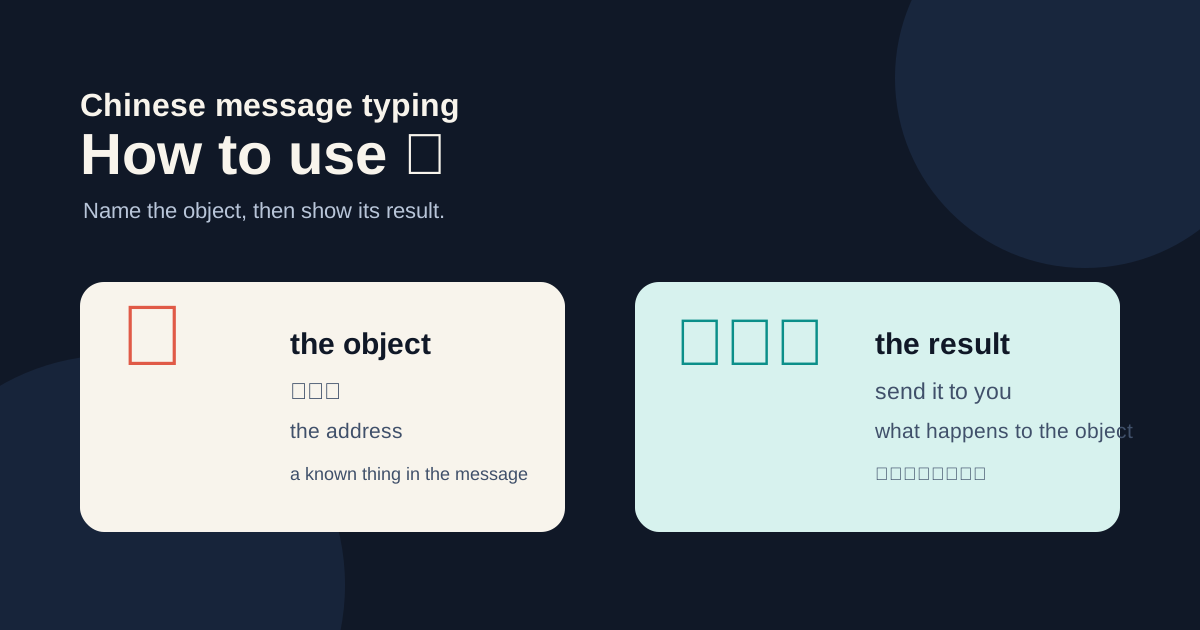
Use 把 (bǎ) before a specific object when the message focuses on what happens to that object. The useful learner pattern is subject + 把 + object + verb + result: 我把作业做完了。 (I finished the homework.) The object 作业 appears before the verb, and 做完 tells the reader what happened to it.
The 把 sentence is helpful for messages about sending, finishing, moving, opening, closing, or changing something. It does not translate as one fixed English word, and it does not belong in every sentence with an object. This guide gives HSK 2 to 4 learners a practical way to type 把 when a known object and its result matter.
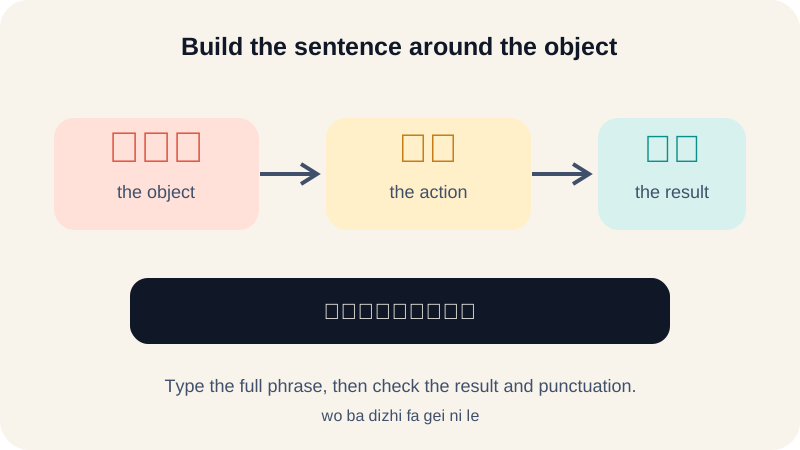
The short answer: put the object before its result
| Message job | Useful learner pattern | Example | Meaning |
|---|---|---|---|
| Finish a specific object | 把 + object + verb + 完 | 我把作业做完了。 | I finished the homework. |
| Send an object | 把 + object + verb + 给 | 我把地址发给你了。 | I sent you the address. |
| Put something somewhere | 把 + object + verb + 在 | 请把书放在桌上。 | Please put the book on the table. |
| Close or open something | 把 + object + verb + result | 你把门关上了吗? | Did you close the door? |
| Record a specific idea | 把 + object + verb + 下来 | 我把问题记下来了。 | I wrote the question down. |
In a 把 sentence, the reader already knows or can identify the object. The verb phrase then says what the subject does to it. The result may be completion, a new location, a recipient, or a changed state. The HSK syllabus gives a study framework, while complete messages show why the result phrase matters.
How to recognize a good 把 message
Ask three questions before typing:
- Is there a specific object? Examples include
这个文件,你的地址,作业, or门in a known situation. - Does the subject do something to that object?
- Can the verb phrase show a result, destination, completion, or change?
If the answer is yes, 把 may make the sentence clear:
我把文件发给你了。(I sent you the file.)请把你的地址写下来。(Please write down your address.)他把手机放在桌上了。(He put the phone on the table.)我们把问题解决了。(We solved the problem.)
The object does not have to be a physical thing. 问题, 作业, 名字, and 地址 can all appear after 把 when the sentence describes what happens to them. The 因为 and 所以 guide gives another way to check the relationship between the clauses in a longer message.
What should come after the object?
The verb after 把 usually needs more information. A bare verb can make the sentence feel unfinished because the reader still needs to know what happened to the object.
| Result type | Common ending | Example | What the ending shows |
|---|---|---|---|
| Completion | 完 | 把报告写完 | The report is finished. |
| Change of state | 好 | 把房间收拾好 | The room is put in order. |
| Destination | 在 + place | 把书放在桌上 | The book has a location. |
| Recipient | 给 + person | 把照片发给我 | Someone receives the photo. |
| Downward or saved result | 下来 | 把地址记下来 | The address is recorded. |
This does not mean every 把 sentence needs the same ending. Time words, 了, modal verbs, and other complements can complete the message. The practical check is simple: after the verb, can the reader tell what changed, where the object went, or whether the action is complete?
把 with requests, plans, and questions
Messages often use 把 when someone asks another person to handle a known object:
请把文件发给我。(Please send me the file.)别把密码发给别人。(Do not send the password to someone else.)可以把地址发给我吗?(Can you send me the address?)你把作业做完了吗?(Did you finish the homework?)
The negative marker or modal verb comes before 把:
我还没把文件发给他。(I have not sent the file to him yet.)我会把地址发给你。(I will send you the address.)我们不能把这个问题放着不管。(We cannot leave this problem unattended.)
The 不 and 没 guide covers why 不 and 没 do different jobs. In a 把 message, check the negative marker before checking the result phrase.
Compare 把 with an ordinary sentence
Many 把 sentences have a normal subject-verb-object version. The difference is where the message puts its attention:
| Sentence | Focus | Natural meaning |
|---|---|---|
我做完作业了。 | The completed action | I finished my homework. |
我把作业做完了。 | What happened to the homework | I got the homework finished. |
我发给你地址了。 | The act of sending | I sent you the address. |
我把地址发给你了。 | The address and its destination | I sent the address to you. |
我喜欢这本书。 | A preference | I like this book. |
The last sentence is a useful warning. 喜欢 describes a preference, so 我把这本书喜欢 is not a natural learner sentence. Use the ordinary subject-verb-object order when the verb does not describe an action or result affecting the object.
The 了, 过, and 着 guide can help when a completed action also needs an aspect marker. 把 organizes the object and result; 了 supplies its own time or completion information.
A Pinyin candidate routine that works
The Ministry of Education Hanyu Pinyin scheme is the reference for the Romanization system. Type ba to find 把, then include the object and result phrase before choosing a candidate.
- Name the object:
zuoye,wenjian,dizhi, ormen. - Choose the action and result:
zuo wan,fa gei,fang zai, orguan shang. - Type the complete phrase, such as
wo ba zuoye zuo wan le. - Select
把from the candidate window and inspect the rest of the sentence. - Check the object, result ending, negative marker, and Chinese punctuation.
Apple's guide to using the Chinese candidate window on Mac explains how candidates are selected on macOS. Other keyboards use different layouts, but the sentence routine remains useful. Typing ba alone can produce several candidates. Typing wo ba dizhi fa gei ni le gives the input method enough context to help you choose the intended phrase.
The 如果 and 就 guide shows the same sentence-level method with a different grammar pattern. Type enough context to test the meaning, then reread the full Hanzi line instead of trusting one Pinyin syllable.
A five-minute typing drill
Read the English meaning first. Type the Chinese from memory, select the candidates, and mark the object and result. Then change one detail, such as the recipient, location, or time.
| Meaning | Target sentence | Pinyin input | Check |
|---|---|---|---|
| I finished the homework. | 我把作业做完了。 | wo ba zuoye zuo wan le | object: 作业; result: 做完 |
| I sent you the address. | 我把地址发给你了。 | wo ba dizhi fa gei ni le | recipient: 你 |
| Please put the book on the table. | 请把书放在桌上。 | qing ba shu fang zai zhuo shang | location: 桌上 |
| Did you close the door? | 你把门关上了吗? | ni ba men guan shang le ma | question plus result |
| I have not sent him the file yet. | 我还没把文件发给他。 | wo hai mei ba wenjian fa gei ta | 还没 before 把 |
| Please write the address down. | 请把地址写下来。 | qing ba dizhi xie xia lai | result: 写下来 |
After the first pass, remove 把 from two sentences and write their ordinary subject-verb-object versions. Then change one result: turn 发给你 into 发给他, or 放在桌上 into 放在包里. The object and the result should still match.
For more real-message prompts, use the Chinese typing practice drills. The Mandarin sentence typing guide covers complete-line accuracy practice.
Mistakes to catch before sending
Using 把 with a general or unknown object
把 works best when the reader can identify the object. 把这个文件发给我 names a specific file. If the message introduces an unknown item for the first time, use ordinary word order until the object is clear.
Stopping after the verb
我把作业做 leaves the result unfinished. Add information such as 完, 好, or a location: 我把作业做完了, 我把房间收拾好了, or 我把书放在桌上了.
Putting the negative marker after 把
Use 我没把文件发给他 or 我还没把文件发给他. The negative marker comes before 把; 我把没文件发给他 breaks the intended pattern.
Using 把 for every object
我喜欢这本书 and 我认识那个人 use ordinary word order. Choose 把 when the verb describes handling, moving, finishing, changing, or placing the object.
Choosing candidates from one syllable
The input method cannot infer the intended message from ba alone. Type wo ba zuoye zuo wan le, then check the character and the result phrase as one line. The complete sentence also makes a wrong 把 candidate easier to notice.
Limits of this shortcut
These patterns cover common HSK 2 to 4 messages. Longer sentences can use several complements, place a time phrase before the subject, or avoid 把 when the object is not specific. Some verbs and fixed expressions follow their own patterns, so a learner shortcut should not replace a trusted example.
把 and 被 also organize attention differently. 我把门关上了 puts the speaker's action first. 门被我关上了 puts the door in the subject position and describes what happened to it. The AllSet Learning guide to 把 and its guide to 被 give additional grammar examples.
FAQ
What does 把 mean in Chinese?
把 is a grammar marker that places a specific object before the verb phrase. The phrase after the object explains what the subject does to it: 我把作业做完了 says what happened to the homework.
When should I use 把?
Use it when the object is identifiable and the action produces a result, destination, completion, or change. 我把地址发给你了 is a good example because the address moves to a recipient.
Does every 把 sentence need a result complement?
The verb phrase usually needs enough information to show what happened to the object. That information may be 完, 好, a location, a recipient, or another complement. Check whether the sentence feels complete after the verb.
Can I leave out 把?
Often. 我做完作业了 and 我把作业做完了 can describe the same event with different focus. Use ordinary subject-verb-object order when the result pattern is unnecessary or the verb describes a preference or state.
How do I type 把 in Pinyin?
Type ba to find 把, which is pronounced bǎ. Include the object and result, such as wo ba dizhi fa gei ni le, before choosing candidates.
What is the difference between 把 and 被?
把 presents the subject handling an object: 我把门关上了. 被 presents the affected object as the subject: 门被我关上了. Choose based on what the message needs to foreground.