How to Type 有点 and 一点 in Chinese Messages
MandarinReps
10/28/2026
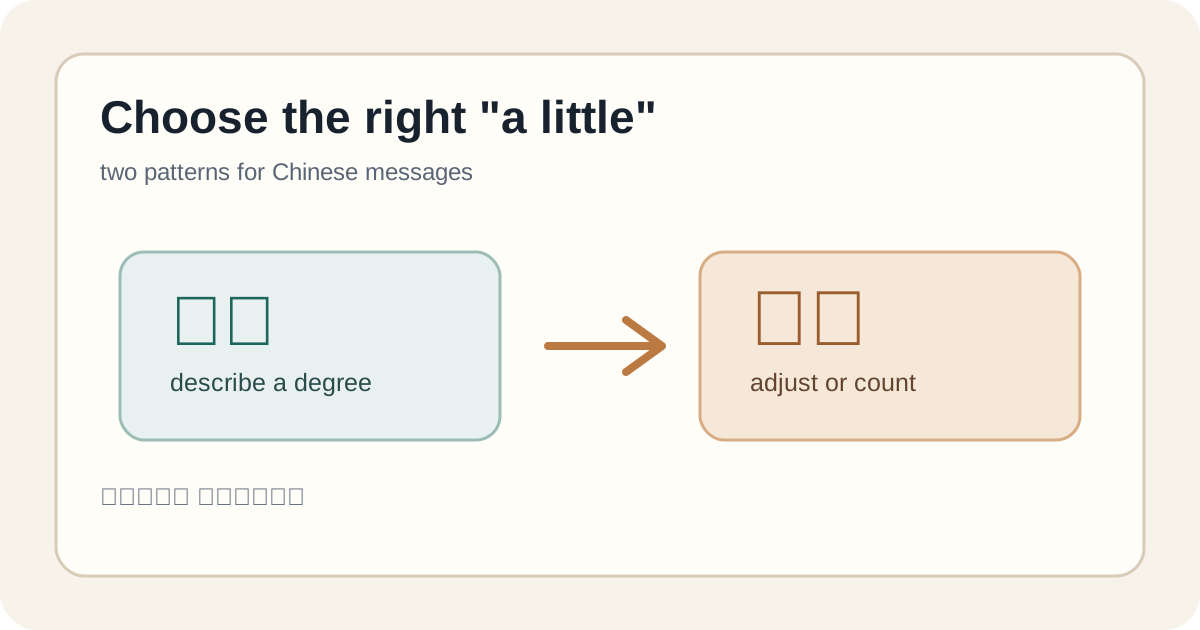
Use 有点 (yǒudiǎn) before an adjective when you mean "a little" and the situation feels less than ideal. Use 一点 (yīdiǎn) after an adjective or verb for a small change, request, or comparison, or before a noun for a small quantity.
Compare these messages:
今天有点冷。(It is a little cold today.)请说慢一点。(Please speak a little more slowly.)我需要一点时间。(I need a little time.)这个比那个贵一点。(This one is a little more expensive than that one.)
English uses "a little" for all four ideas. Chinese changes the word order and often changes the tone. Ask what the phrase is doing before you type the Pinyin: describing an uncomfortable degree, adjusting an action, comparing two things, or naming a small amount.
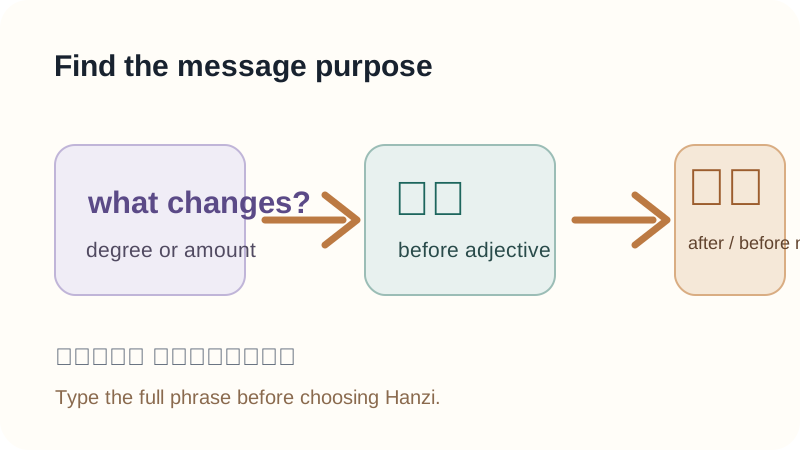
Choose 有点 for a slightly negative impression and 一点 for a small change, comparison, or quantity.
The short answer: 有点 describes, 一点 adjusts or counts
| Message job | Useful pattern | Example | Meaning |
|---|---|---|---|
| Describe a slightly uncomfortable degree | 有点 + adjective | 我有点累。 | I am a little tired. |
| Request a small change | verb or adjective + 一点 | 请慢一点。 | Please slow down a little. |
| Compare two things | adjective + 一点 | 这个大一点。 | This one is a little bigger. |
| Name a small quantity | 一点 + noun | 给我一点水。 | Give me a little water. |
有点 usually comes before the quality being described and can carry a complaint or negative impression. 一点 often comes after the quality or action for a small adjustment, and before a noun for a small amount.
Use 有点 before an adjective
Put 有点 before an adjective when the degree is slightly troublesome, uncomfortable, or disappointing:
今天有点热。(It is a little hot today.)我有点累。(I am a little tired.)这个菜有点咸。(This dish is a little salty.)
The phrase gives the reader your reaction as well as the degree. If you send 这个文件有点长, the reader may hear that the file is inconveniently long. That makes 有点 useful for soft complaints and quick status updates:
我有点不舒服,想先回家。(I feel a little unwell and want to go home first.)这个时间有点晚了。(This time is a little late.)
有点 is not the usual way to ask someone to change an action. For that job, use 一点 after the verb or adjective:
请说慢一点。(Please speak more slowly.)字写大一点。(Write the characters a little larger.)
Use 一点 after an adjective or action
Put 一点 after an adjective when you are comparing, requesting, or describing a small difference:
请说清楚一点。(Please explain it a little more clearly.)这个房间大一点。(This room is a little bigger.)
The sentence often points toward a change. 请说清楚一点 asks the listener to adjust how they explain something. 这个房间大一点 compares the room with another room or an expected size.
You can also put 一点 after a verb when the action should increase or decrease slightly:
再等一点。(Wait a little longer.)少放一点盐。(Add a little less salt.)多练习一点。(Practice a little more.)
In a message, 一点 can sound like a direct request. Add 请, 再, or 吧 when the relationship calls for a softer tone. The guide to 吗, 呢, and 吧 covers these endings.
Use 一点 before a noun for a small amount
When you mean a small quantity, put 一点 before the noun:
我需要一点时间。(I need a little time.)请给我一点水。(Please give me a little water.)
Here, 一点 belongs with the noun. 有点 cannot replace it in a sentence such as 我需要一点时间. The form 有一点 can mean that a small amount exists, as in 桌上有一点水 (There is a little water on the table).
This is different from 有点累. In that sentence, 有点 describes the degree of tiredness. In 一点时间, 一点 counts a small amount of time.
The pattern 一点也不 means "not at all": 这个菜一点也不辣 means the dish is not spicy at all. The negative word changes the meaning from a small degree to zero degree.
Compare a complaint with a request
The same adjective can work with both words, but the message job changes:
| Description with 有点 | Adjustment with 一点 | What the reader hears |
|---|---|---|
今天有点热。 | 今天热一点。 | The first reports an uncomfortable impression. The second asks for or compares a warmer condition. |
我有点累。 | 我想休息一点。 | The first describes your state. The second asks for a little more rest. |
这个字有点小。 | 这个字写大一点。 | The first points out a problem. The second gives an instruction. |
这个方法有点难。 | 请说简单一点。 | The first evaluates the method. The second asks for a simpler explanation. |
When you are messaging a teacher or colleague, check whether you want to report a problem or request a change. 有点 can soften a complaint, while 一点 makes the adjustment clear.
Put the difference into real messages
These examples fit study chats, work coordination, and everyday plans:
我有点忙,晚一点回复你。(I am a little busy. I will reply a little later.)请把地址写清楚一点。(Please write the address a little more clearly.)我需要一点时间看这份文件。(I need a little time to read this file.)你再说慢一点,我没听懂。(Please say it a little more slowly. I did not understand.)
The first describes a problem, the second and fourth request an adjustment, and the third names a small amount of time. Label the job before opening the input method so you do not place 一点 before an adjective by habit.
The 一点 and 一下 guide covers another use of 一点. The 还没 and 还不 guide shows another case where an English "still" translation hides a different Chinese pattern. The real-message typing drills add more prompts.
A Pinyin routine for 有点 and 一点
The Ministry of Education overview of Hanyu Pinyin describes Pinyin as a tool used in learning and communication. Use a sentence-level routine:
- Decide whether you are describing a degree, requesting a change, comparing two things, or naming a quantity.
- Type the complete phrase, such as
wo you dian leiorqing shuo man yi dian. - Select
有点or一点from the candidate window. - Check the word after the phrase, or the word before
一点when it names a quantity. - Read the message once for grammar and once for tone.
Apple's Chinese input method guide explains how the candidate window presents possible characters for an input code. Windows, Android, and iPhone controls differ, but typing the whole phrase gives you useful context on any keyboard.
Typing you dian alone can produce candidates without telling you whether the next word will be an adjective or a noun. Type wo you dian lei to practice the descriptive pattern. Type wo xuyao yi dian shijian to practice quantity.
If the keyboard selects the wrong character, the wrong-character troubleshooting guide gives a review routine. The Mandarin sentence typing practice guide explains why complete messages are better practice than isolated candidate lists.
A five-minute typing drill
Read the English prompt, type the Chinese sentence from memory, and label its job before you send it:
| English prompt | Target sentence | Pinyin input | Check |
|---|---|---|---|
| I am a little tired. | 我有点累。 | wo you dian lei | description |
| Please speak more slowly. | 请说慢一点。 | qing shuo man yi dian | request |
| I need a little time. | 我需要一点时间。 | wo xuyao yi dian shijian | quantity |
| This one is a little bigger. | 这个大一点。 | zhege da yi dian | comparison |
| The dish is a little salty. | 这个菜有点咸。 | zhege cai you dian xian | description |
| This dish is not spicy at all. | 这个菜一点也不辣。 | zhege cai yi dian ye bu la | negative pattern |
On a second pass, change one part of each sentence. Turn 我有点累 into 我有点忙. Turn 请说慢一点 into 请写清楚一点. Keep the word order visible while the vocabulary changes.
Mistakes to catch before sending
Putting 一点 before an adjective
今天一点热 is not the normal way to say "It is a little hot." Use 今天有点热. Put 一点 after the adjective for a comparison or request, such as 今天暖和一点.
Using 有点 for a request
请有点慢 does not clearly ask someone to slow down. Use 请慢一点 or 请说慢一点.
Forgetting the noun after 一点
我需要一点 feels unfinished when you mean a small amount. Add the noun: 我需要一点时间.
Missing the negative pattern
一点也不辣 means "not spicy at all." It has a different meaning from 有点辣, which means "a little spicy" and may carry a mild complaint. The Chinese punctuation typing guide covers punctuation for short requests.
FAQ
What is the difference between 有点 and 一点?
有点 usually comes before an adjective and describes a degree with a slightly negative impression. 一点 comes after an adjective or verb for a small change, request, or comparison, and before a noun for a small amount.
Can I say 一点累 for "a little tired"?
Use 有点累. In the usual degree pattern, 一点 does not go directly before the adjective. Use 累一点 when you are comparing or asking for a change in the degree of tiredness.
How do I type 有点 with Pinyin?
Type you dian inside the complete phrase, such as wo you dian lei, then choose 有点 from the candidate window. Check that the next word is an adjective or adjective phrase.
How do I type 一点?
Type yi dian inside the full phrase, such as qing shuo man yi dian or yi dian shui, then select 一点. Its position depends on whether you are making a request, comparison, or quantity phrase.
Is 有点 rude?
有点 can soften a complaint, but it still tells the reader that something feels less than ideal. 这个方案有点复杂 is a mild negative evaluation. Add a reason or a suggestion when the relationship is formal.
What does 一点也不 mean?
一点也不 means "not at all," as in 我一点也不累. The negative word 不 changes the meaning from a small degree to zero degree.
Limits of this shortcut
These patterns cover common HSK 2 to 4 messages. Regional pronunciation may add the 儿 sound, as in 一点儿 and 有点儿, while the sentence roles remain the same. Tone also depends on the adjective, the request, and the relationship between the writers.
When you are describing a slightly negative impression, start with 有点. When you need a small change, comparison, or quantity, consider 一点. Type the complete sentence, select the Hanzi, and reread the message as the recipient would.