How to Type 吗, 呢, and 吧 in Chinese Messages
MandarinReps
10/18/2026
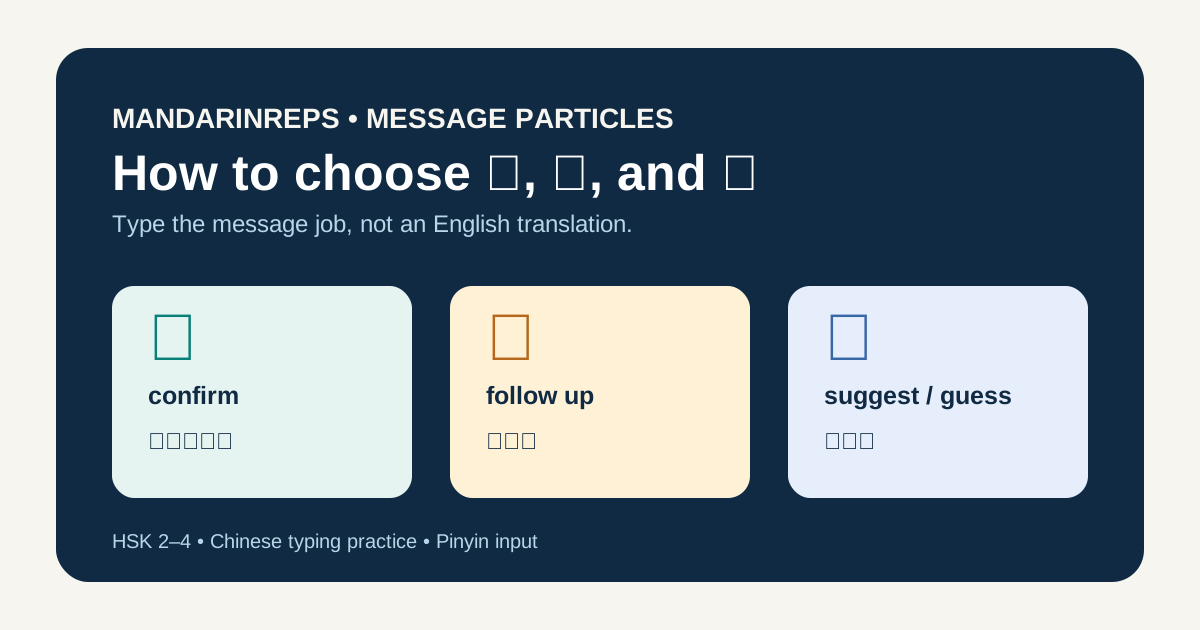
Use 吗 (ma) at the end of a clear yes-or-no question. Use 呢 (ne) to ask about a person or thing already in the conversation, or to keep a question open. Use 吧 (ba) for a suggestion, a softened request, or a guess that you expect the other person to confirm.
Compare these three messages:
你今天有空吗?(Are you free today?)你呢?(What about you?)我们明天见吧。(Let's meet tomorrow.)
English translations overlap, but the particles do different jobs. An input method can offer candidates; it cannot decide whether you are confirming, following up, suggesting, or guessing. Type the complete message, choose the Hanzi candidate, and check the punctuation before sending.
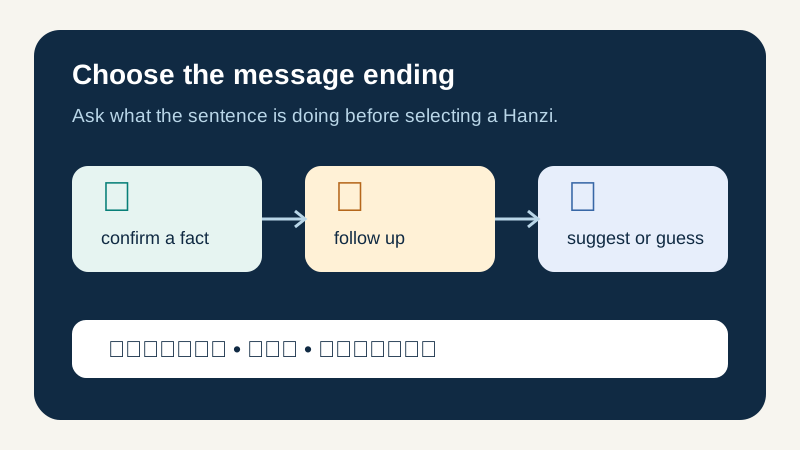
The short answer: confirm, follow up, or suggest
| Message job | Useful learner default | Example | Meaning |
|---|---|---|---|
| Confirm a yes-or-no fact | 吗 | 你到了吗? | Have you arrived? |
| Ask about the other person | 呢 | 你呢? | What about you? |
| Ask about an open topic | 呢 | 你的手机呢? | Where is your phone? |
| Make a suggestion | 吧 | 我们走吧。 | Let's go. |
| Soften a request | 吧 | 你慢一点儿吧。 | Please slow down a little. |
| Offer a likely guess | 吧 | 他今天会来吧? | He will come today, right? |
These defaults work for short messages, but context matters. 吗 usually turns a statement into a yes-or-no question. 呢 points back to a person, object, or topic that is already active. 吧 changes the speaker's stance, so the same sentence can sound like a suggestion or a tentative guess.
Use 吗 for a clear yes-or-no question
Place 吗 at the end of a statement when the expected answer is yes or no:
你今天上班吗?(Are you working today?)你喜欢喝茶吗?(Do you like drinking tea?)文件在桌子上吗?(Is the file on the desk?)他已经回家了吗?(Has he already gone home?)
Keep the normal Chinese word order. Type the sentence, add ma, then select 吗 from the candidate list.
Do not add 吗 after a question word such as 什么, 谁, 哪里, or 什么时候. These sentences already ask for specific information:
| Question type | Chinese message | Why it works |
|---|---|---|
| Yes-or-no question | 你明天来吗? | The answer can be yes or no. |
| What question | 你明天做什么? | 什么 asks for the activity. |
| Who question | 谁发的消息? | 谁 asks for the person. |
| Where question | 文件在哪儿? | 哪儿 asks for the location. |
| When question | 你什么时候回来? | 什么时候 asks for the time. |
你明天做什么吗? can appear in a special context, but it is not the normal beginner pattern for asking what someone will do. First identify whether the answer is a confirmation or a missing piece of information.
Use 呢 for a follow-up or an open topic
呢 often keeps the current topic in view. The shortest use is a follow-up:
我很好,你呢?(I am fine. How about you?)我明天上班,你呢?(I work tomorrow. What about you?)他已经到了,你的朋友呢?(He has arrived. What about your friend?)
It can also ask where a person or thing is when the conversation has already made it relevant:
我的手机呢?(Where is my phone?)老师呢?(Where is the teacher?)你的文件呢?(What about your file?)
In a fuller question, 呢 can keep the tone conversational:
你在看什么呢?(What are you watching?)他怎么还没来呢?(Why has he still not arrived?)
Ask what topic the particle is pointing back to. If the other person has just answered a question about themselves, 你呢? is a natural follow-up. If you need a simple confirmation, use 吗 instead.
Use 吧 for a suggestion, request, or guess
Use 吧 when you want to move an action forward without making the message sound like a command:
我们先吃饭吧。(Let's eat first.)你早点休息吧。(Get some rest early.)请再说一遍吧。(Please say it one more time.)
The particle can also show a guess:
他是新老师吧?(He is the new teacher, right?)你应该知道吧?(You probably know, right?)这个方法可以吧?(This method should work, right?)
Punctuation helps the reader. 我们走吧。 is a suggestion. 我们走吧? sounds like the speaker is checking whether the other person agrees. 他今天会来吧? is a guess seeking confirmation, while 他今天会来吗? asks for a direct yes-or-no answer.
Compare the three particles in a chat
| Situation | Message | What the writer is doing |
|---|---|---|
| Checking availability | 你现在方便吗? | Asking for a yes-or-no answer. |
| Returning the same question | 你呢? | Asking the other person about themselves. |
| Suggesting a time | 我们八点见吧。 | Proposing a plan. |
| Guessing about a plan | 他也去吧? | Guessing and asking for confirmation. |
| Asking about an item in context | 钥匙呢? | Asking where the relevant item is. |
Read the message job before opening the candidate window. If you are checking a fact, start with 吗. If the conversation has already supplied one person, item, or answer and you want the next one, start with 呢. If you are proposing or guessing, try 吧.
The Chinese punctuation typing guide covers the question mark and comma choices that make these short messages easier to read. The 还是 and 或者 guide gives more practice with questions where the reader must compare options.
A Pinyin candidate routine that works
The Ministry of Education Hanyu Pinyin scheme is the reference for the Romanization system. Standard Chinese keyboards usually let you type Pinyin without tone marks, so the surrounding sentence supplies much of the context.
- Decide the message job: confirm, follow up, suggest, or guess.
- Type the whole phrase, such as
ni jin tian you kong ma,ni ne, orwomen ming tian jian ba. - Select the particle from the candidate list:
吗,呢, or吧. - Read the full line again. Check the particle, punctuation, and tone.
- Send the sentence only after the ending matches your intention.
Apple's guide to using the Chinese candidate window on Mac explains how to choose characters from candidates. Other keyboards use different layouts, but the sentence-level routine is the same. Typing ma alone may show 吗, 妈, 马, or other candidates. Typing the surrounding words gives the input method more context and makes your own review easier.
If the candidate window shows a character you do not recognize, use the unknown-character typing guide to keep the message moving without guessing from memory.
A five-minute typing drill
Read the English meaning first. Type the Chinese from memory, choose the final particle, and explain why it is 吗, 呢, or 吧.
| Meaning | Target sentence | Pinyin input | Check |
|---|---|---|---|
| Are you free today? | 你今天有空吗? | ni jintian you kong ma | yes-or-no confirmation |
| Are you at home? | 你在家吗? | ni zai jia ma | yes-or-no confirmation |
| What about you? | 你呢? | ni ne | follow-up |
| Where is the file? | 文件呢? | wenjian ne | open topic |
| Let's meet tomorrow. | 我们明天见吧。 | women mingtian jian ba | suggestion |
| He is probably busy, right? | 他很忙吧? | ta hen mang ba | tentative guess |
After the first pass, change only the final particle and punctuation:
你今天有空吗?asks for a direct confirmation.你今天有空呢?is unusual without more context because呢needs an open topic or a conversational frame.你今天有空吧?sounds like the speaker expects that the person is free and wants confirmation.
Then turn the suggestion 我们明天见吧。 into the direct question 我们明天见吗?. The first proposes a plan. The second checks whether the plan is true or agreed.
The Chinese typing practice drills provide more short prompts. The Mandarin sentence typing guide explains why typing a complete line is more useful than memorizing isolated Hanzi candidates.
Mistakes to catch before sending
Adding 吗 after a question word
Use 你什么时候回来? for "When will you come back?" and 你明天回来吗? for "Will you come back tomorrow?"
Treating 呢 as a universal "what about"
你呢? works when the conversation has just supplied information about another person. 呢 also points to a relevant item or an open situation. It is not a direct replacement for 吗 in every question.
Using 吧 when you need a firm answer
你明天上班吗? asks clearly whether the person works tomorrow. 你明天上班吧? sounds like a guess that expects agreement. Choose the ending that matches your level of certainty.
Forgetting the question mark
你呢? and 你呢。 do not feel the same in a chat. The question mark tells the reader that you want a response. The 在 and 再 typing guide includes more punctuation checks for short messages.
Choosing from one syllable
ma, ne, and ba can each produce more than one Hanzi candidate. Type ni jin tian you kong ma instead of choosing a character after ma alone. Then inspect the full line.
Translating the English ending word by word
English "right?", "what about you?", and "let's" do not map to one Chinese particle in every sentence. Start with the communicative job, then type the complete Chinese message.
Limits of this shortcut
These patterns cover common HSK 2 to 4 messages. Tone, relationship, punctuation, and the surrounding conversation can change how 吧 and 呢 feel. 吗 is a useful default for yes-or-no questions. Chinese also uses question words, choices, and rising intonation in speech.
When a message feels ambiguous, write the intended answer in English first: yes or no, the other person or item, or a proposed action. Then type the Chinese line and reread the ending. The 会, 能, and 可以 guide also starts with the sentence's purpose instead of an English translation.
FAQ
When should I use 吗 in a Chinese message?
Use 吗 at the end of a statement when you want a yes-or-no answer, such as 你今天有空吗?. Keep the normal Chinese word order and add the question particle after the complete statement.
What does 呢 mean at the end of a sentence?
呢 points to a person, thing, or topic already active in the conversation. In 我很好,你呢? it asks about the other person. In 我的手机呢? it asks about the relevant phone.
Is 吧 a question particle?
吧 can appear in a question when the speaker is making a guess or seeking agreement, as in 他是老师吧?. It also appears in suggestions such as 我们走吧。, so it does not have the single yes-or-no job of 吗.
Can I say 你今天有空呢?
It can be understood, but it needs a conversational context. For a simple confirmation, type 你今天有空吗?. Use 呢 when you are following an existing topic or asking a related open question.
What is the difference between 你走吗 and 你走吧?
你走吗? asks whether the person will leave. 你走吧。 suggests or permits the person to leave. The particle changes the writer's purpose from checking a fact to moving the action forward.
How do I type 吗, 呢, and 吧 with Pinyin?
Type ma, ne, and ba, then choose the intended Hanzi from the candidate window. Include the words before the particle, reread the complete sentence, and check the punctuation before sending.