How to Type 为什么 and 怎么 in Chinese Messages
MandarinReps
10/26/2026
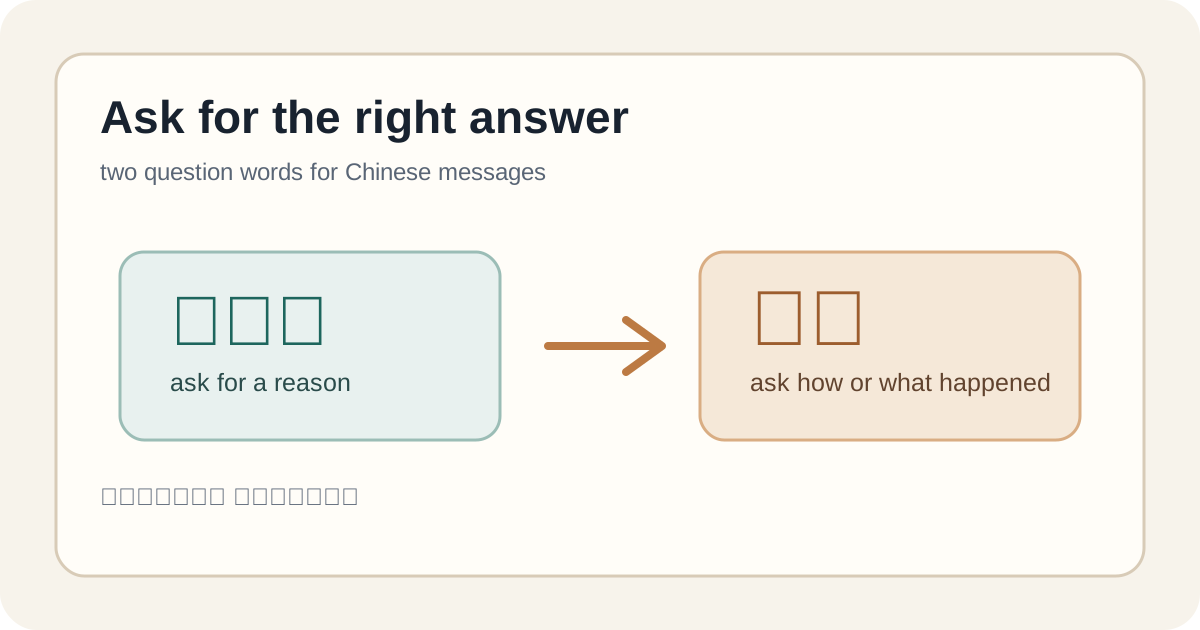
Use 为什么 (wèishénme) when you want a reason. Use 怎么 (zěnme) when you want to ask how to do something, and in some conversational questions when you mean "what happened?" or "how come?"
Compare these messages:
你为什么学习中文?(Why are you studying Chinese?)这个字怎么打?(How do you type this character?)你怎么了?(What's wrong?)你怎么还没回复?(How come you have not replied yet?)
The English translation can make the last two feel confusing. Start with the job of the message. Are you asking for a cause, a method, or an explanation for a current situation? Type the complete sentence with your Pinyin input method, then check whether the question word matches the information you need.
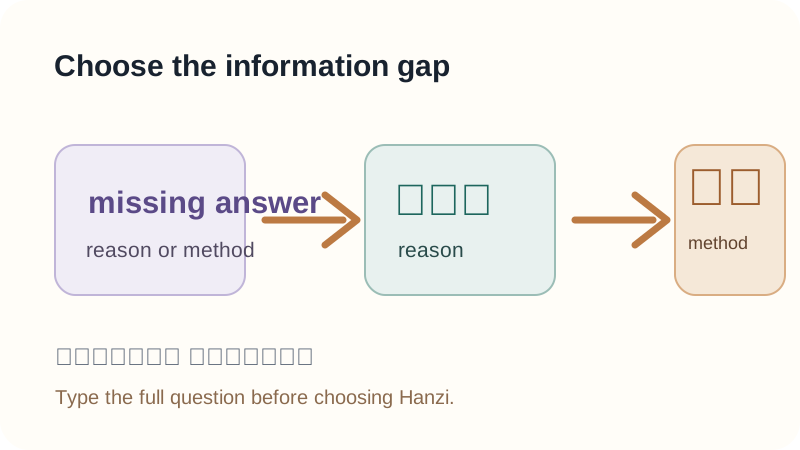
Choose the information you need, then place 为什么 or 怎么 before the rest of the question.
The short answer: 为什么 asks for a reason
| Message job | Useful pattern | Example | Meaning |
|---|---|---|---|
| Ask for a reason | Subject + 为什么 + verb | 你为什么迟到? | Why are you late? |
| Ask for a method | 怎么 + verb | 这个字怎么打? | How do you type this character? |
| Ask what happened | 怎么了? | 你怎么了? | What's wrong? |
| Ask why a situation remains | 怎么还 + verb | 你怎么还没走? | How come you have not left yet? |
These are useful learner defaults for HSK 2 to 4 messages. 为什么 points toward a cause. 怎么 points toward a way of doing something, or it reacts to a situation that seems unexpected. Context and punctuation still affect the tone.
Use 为什么 to ask for a cause
Put 为什么 before the verb phrase that you want explained:
你为什么学习中文?(Why are you studying Chinese?)你为什么不去?(Why are you not going?)他为什么没来?(Why did he not come?)这个文件为什么打不开?(Why will this file not open?)
The answer usually gives a reason:
因为我喜欢中国电影。(Because I like Chinese films.)因为今天下雨。(Because it is raining today.)因为文件格式不对。(Because the file format is wrong.)
In a chat, 为什么 can sound direct when the question concerns a decision or a delay. That is not a fixed rule, but the relationship and the surrounding words matter. If you want a softer request for context, try:
方便告诉我原因吗?(Could you tell me the reason?)你是因为下雨才没来吗?(Did you not come because of the rain?)
Use 为什么 when the missing information is the cause. If the missing information is the process, choose 怎么 instead.
Use 怎么 to ask how
Use 怎么 with an action when you want instructions, a method, or a route:
这个字怎么打?(How do you type this character?)中文输入法怎么设置?(How do you set up the Chinese input method?)这道题怎么做?(How do you do this problem?)你怎么去学校?(How do you get to school?)
The answer names a method or a sequence:
先打开设置,再选择键盘。(First open Settings, then choose Keyboard.)坐地铁去。(Go by subway.)先看题目,再写答案。(Read the question first, then write the answer.)
The phrase 怎么做 is especially useful when a learner needs help with a task. The phrase 怎么打 asks about typing or entering a character. Add the object that matters so the reader knows what you want to learn.
Use 怎么了 for a problem or change
怎么了? is a set conversational question. It can mean "What's wrong?", "What happened?", or "What is going on?" depending on the situation:
你怎么了?(What's wrong?)电脑怎么了?(What's wrong with the computer?)今天怎么了?(What is going on today?)
Here, 怎么 is not asking for a step-by-step method. It reacts to a problem or a change and invites the other person to explain. If you want to ask for the cause directly, use 为什么:
电脑怎么了?asks what problem the computer has.电脑为什么不能开机?asks why the computer cannot start.
Both questions can fit the same conversation. The first opens the problem. The second asks for its cause.
Use 怎么还 and 怎么又 carefully
In messages, 怎么还... often expresses surprise that a situation has continued:
你怎么还没睡?(How come you are still not asleep?)你怎么还没回复?(How come you have not replied yet?)
怎么又... can react to a repeated event:
你怎么又忘了?(How come you forgot again?)文件怎么又打不开了?(Why will the file not open again?)
These patterns can sound impatient if the reader is already under pressure. Add a reason for the message or use a plain request when you need a neutral tone:
我还没看到文件,可以再发一次吗?(I have not seen the file yet. Could you send it again?)方便的时候请回复我。(Please reply when convenient.)
The 吗, 呢, and 吧 guide gives more practice choosing a question ending after you decide what the question asks.
Compare 为什么, 怎么, 怎么了, and 怎么样
The last word in this table is useful because learners often confuse it with 怎么:
| Word or phrase | Main job | Example | Information requested |
|---|---|---|---|
| 为什么 | Ask for a reason | 你为什么迟到? | The cause |
| 怎么 | Ask for a method or process | 这个怎么做? | The way to do it |
| 怎么了 | Ask what problem happened | 你的手机怎么了? | The current problem |
| 怎么样 | Ask for an evaluation or opinion | 这个方法怎么样? | Whether it is good or acceptable |
怎么样 can also ask about a person's condition or a proposed plan. It is not the usual replacement for 怎么 in a method question. 这个字怎么打 asks how to enter the character. 这个方法怎么样 asks whether the method is good.
For more practice with actions and sequences, read the 先 and 再 guide. The 会, 能, and 可以 guide covers questions about ability and permission.
Put the difference into real messages
These examples fit study chats, work messages, and everyday coordination:
你为什么改时间?(Why did you change the time?)时间怎么改?(How do I change the time?)这个链接怎么打不开?(Why will this link not open?)你怎么了?需要帮忙吗?(What's wrong? Do you need help?)这个安排怎么样?(What do you think of this arrangement?)
Look at the information gap in each message. The first asks about a decision. The second asks for an action. The third describes a problem and asks for an explanation in a conversational way. The fourth checks on a person. The fifth asks for an opinion.
Punctuation makes the question boundary easy to see:
你为什么改时间?时间怎么改?
The two questions are short, but they request different answers. The Chinese punctuation typing guide covers question marks and commas in longer messages.
A Pinyin routine for 为什么 and 怎么
The Ministry of Education overview of Hanyu Pinyin describes Pinyin as a tool used in learning and communication. On a Chinese keyboard, the exact candidate controls vary, so use a sentence-level routine:
- Decide the information gap: cause, method, problem, or opinion.
- Type the complete phrase, such as
ni weishenme bu laiorzhege zi zenme da. - Select
为什么or怎么from the candidate list. - Check the verb after the question word.
- Read the full line once for meaning and once for tone.
Typing weishenme as one phrase is safer than choosing characters one syllable at a time. Typing zenme in a complete phrase helps you review whether the next word describes a method or a problem. Apple's Chinese input method guide explains that the candidate window shows possible characters for an input code and lets you select the intended candidate.
If the input method selects the wrong character, the wrong-character troubleshooting guide gives a longer review routine. The real-message typing drills add short prompts for practicing the same check.
A five-minute typing drill
Read the English prompt, type the Chinese from memory, and label the information you are requesting:
| English prompt | Target sentence | Pinyin input | Check |
|---|---|---|---|
| Why are you late? | 你为什么迟到? | ni weishenme chidao | reason |
| How do I type this character? | 这个字怎么打? | zhege zi zenme da | method |
| What's wrong with your phone? | 你的手机怎么了? | nide shouji zenme le | problem |
| How do you get to school? | 你怎么去学校? | ni zenme qu xuexiao | method |
| Why have you not replied yet? | 你怎么还没回复? | ni zenme hai mei huifu | continued situation |
| What do you think of this plan? | 这个计划怎么样? | zhege jihua zenmeyang | opinion |
On a second pass, change only the missing information. Turn 你为什么迟到 into 你为什么不来. Turn 这个字怎么打 into 这个文件怎么发. The question pattern stays familiar while the sentence becomes useful for another message.
The Mandarin sentence typing guide explains why complete sentences are better practice than isolated candidate lists.
Mistakes to catch before sending
Using 为什么 for a method
这个字为什么打? asks for a reason and sounds different from the intended method question. Use 这个字怎么打? when you want the input steps.
Using 怎么 for every English why
怎么 can express "how come" in patterns such as 你怎么还没回复?. It does not replace 为什么 in every question. Choose 为什么 when the answer should explain a cause.
Treating 怎么了 as a method question
你怎么了? asks what happened or what is wrong. For instructions, use a verb after 怎么, such as 这个怎么设置?.
Confusing 怎么 and 怎么样
怎么做 asks how to do something. 怎么样 asks for an evaluation. The extra 样 changes the question job.
Forgetting the object
怎么打? can work when the conversation already names the character. If the message may be forwarded or read later, write 这个字怎么打? so the reader knows what you mean.
FAQ
What is the difference between 为什么 and 怎么?
为什么 asks for a reason. 怎么 asks for a method or can react to a problem in conversational patterns. Compare 你为什么学习中文? with 你怎么学习中文?. The first asks for your reason. The second asks about your study method.
Can 怎么 mean why?
Yes, in patterns such as 你怎么还没走? or 你怎么了?. The meaning comes from the construction and context. Use 为什么 for a plain reason question.
What does 怎么了 mean?
怎么了? asks what happened or what problem exists. It can refer to a person, device, plan, or situation, as in 电脑怎么了?.
How do I type 为什么 with Pinyin?
Type weishenme, then choose 为什么 from the candidate list. Type the surrounding words first when the input method shows several candidates.
How do I type 怎么?
Type zenme and select 怎么. Continue with the verb or phrase that names the method, such as 怎么打 or 怎么设置.
How can I ask why more politely?
Add context or a softening phrase when the relationship calls for it: 方便告诉我原因吗? asks politely for the reason. You can also explain what you need to decide before asking the question.
What is the difference between 怎么 and 怎么样?
怎么 asks how to do something or reacts to a problem. 怎么样 asks for an opinion or evaluation. Use 这个怎么做? for instructions and 这个方法怎么样? for an opinion.
Limits of this shortcut
These patterns cover common HSK 2 to 4 messages. Tone depends on the relationship, punctuation, and the situation being discussed. A question about a missed reply may sound urgent even when the grammar is correct. Add a reason, a time reference, or a polite request when the reader needs more context.
Use the question word that matches the missing information, then type the entire sentence and reread it as the recipient would. A short Chinese question becomes easier to answer when its purpose is clear.