How to Type 先 and 再 in Chinese Messages
MandarinReps
10/21/2026
Use 先 (xiān) for the first action and 再 (zài) for the action that comes later: 先吃饭,再学习。 (Eat first, then study.) A useful message pattern is 先 + action, 再 + action. The first clause sets the order. The second clause tells the reader what happens after it.
In a chat, you can keep both words, start with only 先, or use 再 in a reply about a later step: 我先开会,再给你回消息。 (I will have a meeting first, then reply to you.) The complete sentence makes the sequence visible while you type and helps the Chinese input method choose the right Hanzi.
This guide gives HSK 2 to 4 learners a sentence-level routine for typing 先 and 再, choosing Pinyin candidates, using the Chinese comma, and telling sequence apart from location, repetition, or a condition.
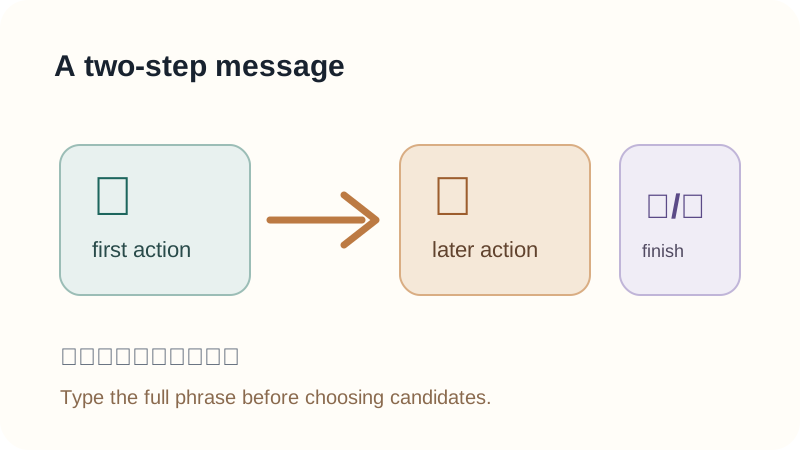
The short answer: first step, later step
| Message job | Useful learner pattern | Example | Meaning |
|---|---|---|---|
| Name the first step | 先 + action | 先看文件。 | Read the file first. |
| Name the later step | 再 + action | 再回复我。 | Reply to me afterward. |
| Give a two-step plan | 先..., 再... | 先吃饭,再学习。 | Eat first, then study. |
| Put the subject before both | subject + 先..., 再... | 我先回家,再给你打电话。 | I will go home, then call you. |
| Ask someone to follow order | 先..., 再... | 先发地址,再订票。 | Send the address, then book tickets. |
先 points to the earlier action. 再 points to the later action, often one that the speaker plans or requests. In a short message, the subject can disappear when the conversation already makes it clear who will act.
Use 先 for the first action
Put 先 before the verb or action that should happen first:
先打开文件。(Open the file first.)我先回家。(I will go home first.)先问老师。(Ask the teacher first.)我们先吃饭。(We will eat first.)
The position can change with the message. 我先看文件 puts the subject first. 先看一下文件 sounds like a short instruction. Both sentences identify the same first step.
When a sentence contains two actions, 先 gives the reader a reason to wait for the second part:
我先看文件,再回复你。(I will read the file first, then reply to you.)我们先确认地址,再买票。(We will confirm the address first, then buy the tickets.)你先休息一下,再继续学习。(Rest for a moment first, then continue studying.)
Use 再 for the next or later action
Use 再 before an action that will happen after the first step:
再回复我。(Reply to me afterward.)明天再聊。(Let's talk tomorrow.)等我到家,再打电话。(Wait until I get home, then call.)看完文件,再告诉我。(Tell me after you finish reading the file.)
再 often points forward. It can mark a later action in a plan, a request, or a condition that has to be completed first. The Chinese grammar guide for sequencing with xian and zai gives more examples of this order.
The word can also mean "again" in a different sentence:
请再说一次。(Please say it again.)我想再看一遍。(I want to look at it one more time.)
The surrounding verb tells you which meaning is active. In 先看文件,再回复, 再 marks the next step. In 再说一次, it marks a repeated action.
Compare the common sequence patterns
| Pattern | Example | Use it when |
|---|---|---|
| 先..., 再... | 先看文件,再回复你。 | You are setting an order or plan. |
| 先..., 然后... | 先看文件,然后回复你。 | You are describing what happens next. |
| 等..., 再... | 等我到家,再给你打电话。 | The later action waits for a condition. |
| 如果..., 就... | 如果下雨,我们就不去。 | The second action depends on a possible condition. |
先...再... is useful when the speaker controls or proposes the sequence. 然后 can narrate the next event without the same planning feel. 等...再... tells the reader to wait. The 如果 and 就 guide covers a condition and its consequence, which has a different relationship from a simple two-step plan.
Both are understandable. Choose 再 when you want to make the next planned step compact and clear.
先 and 再 in digital messages
The pattern works well for plans, requests, work updates, and study arrangements:
我先开会,再给你回消息。(I will have a meeting first, then reply to you.)你先看一下,明天再告诉我。(Look at it first, then tell me tomorrow.)先把地址发给我,再订票。(Send me the address first, then book the tickets.)我们先确认时间,再决定。(We will confirm the time first, then decide.)等我到家,再给你打电话。(I will call you after I get home.)
The order can be important to the reader. If someone needs an address before booking a ticket, placing 发地址 before 订票 prevents the message from sounding incomplete. An object-first construction can also make the order clear when the object is the focus.
You can send the first step and add the later step in a second message when the plan is already clear. For a standalone practice sentence, keep both clauses so you can check the complete sequence.
Punctuation that shows the order
Use the Chinese comma , between the first and later clauses:
先看文件,再回复我。我先回家,再给你打电话。等我到家,再联系你。
End the message with 。 when it is a statement, ? when you are asking about the order, or ! when the request has strong feeling:
你先看一下,再告诉我,可以吗?先把作业写完,再玩游戏!
The Chinese punctuation typing guide explains how to practise the fullwidth comma, question mark, and other marks in real messages. Punctuation helps the reader see where the first action ends, especially when the subject is omitted.
A Pinyin candidate routine that works
The Ministry of Education Hanyu Pinyin scheme is the reference for the Romanization system. Most Chinese keyboards let you type Pinyin without tone marks, so type the whole phrase before choosing the Hanzi.
- Type the first action:
xian kan wenjian,xian chi fan, orxian hui jia. - Type the later action:
zai huifu wo,zai xuexi, orzai da dianhua. - Choose
先and再from the candidate window. - Read the sentence again and check that the actions are in the intended order.
- Add the Chinese comma and final punctuation before sending.
Apple's guide to using the Chinese candidate window on Mac explains how to select characters from the candidates. Other keyboards use different layouts, but the sentence routine is similar. Typing xian alone can produce several candidates. Typing wo xian kan wenjian zai huifu ni gives you more context for both selection and proofreading.
The Chinese Tests Service HSK syllabus gives a broader study framework. These drills keep the focus on complete digital messages, so you practise the word order and the Hanzi together.
A five-minute typing drill
Read the English meaning first. Type the Chinese from memory, choose the candidates, and mark the first and later actions.
| Meaning | Target sentence | Pinyin input | Check |
|---|---|---|---|
| Eat first, then study. | 先吃饭,再学习。 | xian chi fan zai xuexi | first: 吃饭 |
| I will read the file, then reply. | 我先看文件,再回复你。 | wo xian kan wenjian zai huifu ni | later: 回复 |
| Send me the address, then book. | 先把地址发给我,再订票。 | xian ba dizhi fa gei wo zai ding piao | first: 发地址 |
| Wait until I get home, then call. | 等我到家,再打电话。 | deng wo dao jia zai da dianhua | condition: 到家 |
| We will confirm, then decide. | 我们先确认,再决定。 | women xian queren zai jueding | order: 确认 then 决定 |
| Talk tomorrow. | 明天再聊。 | mingtian zai liao | later: 明天 |
After the first pass, make two changes:
- Remove the subject where the context is clear:
我先看文件,再回复你。becomes先看文件,再回复。 - Replace
再with然后and read the difference:我先看文件,然后回复你。
For more real-message prompts, use the Chinese typing practice drills. The Mandarin sentence typing guide explains why a complete line gives you a better accuracy check than isolated Hanzi recall.
Mistakes to catch before sending
Confusing 再 with 在
再 marks a later or repeated action. 在 can mark a location or an action in progress. Compare 我再回你 (I will reply to you later) with 我在回你 (I am replying to you now). The 在 and 再 typing guide has more examples.
Stopping after 先
我先看文件 can be a complete message if the next step is understood. In a sequence drill, add the second action: 我先看文件,再回复你。 The reader should know what follows the first step.
Using 再 for every meaning of "then"
再 works well for a planned or later action. A story can use 然后 to move from one event to the next. A sentence such as 我先到公司,然后开会 describes a sequence; 我先到公司,再开会 sounds more like a plan or instruction.
Confusing sequence with a condition
先确认地址,再订票 gives two actions in order. 如果没有地址,我们就不订票 gives a possible condition and its result. Choose the pair that matches the message job.
Using 又 when the action is planned later
再 often points to a future or later action: 明天再聊。 又 commonly describes something that happened again or is happening again: 他又迟到了。
Choosing candidates from one syllable
Type xian or zai inside a complete phrase rather than accepting the first candidate. Then inspect the first action, the later action, the comma, and the final punctuation as one message.
Limits of this shortcut
The pattern 先...再... covers many HSK 2 to 4 messages about plans, requests, and daily routines. It does not replace every use of 然后, 等, or 如果...就.... A longer message may contain several steps, and 再 may mean "again" rather than "after that."
When the meaning feels unclear, write the message job first: name the first action, describe the later action, or ask someone to wait. Then type the complete Chinese sentence and check whether the second clause really follows the first.
FAQ
What is the difference between 先 and 再?
先 introduces the action that happens first. 再 introduces a later action. In 我先吃饭,再学习, eating comes before studying.
Do I have to use both 先 and 再?
No. 先看一下。 is a complete instruction, and 明天再聊。 is a complete message about a later conversation. Use both when the reader needs to see the full order.
Can 再 mean "again"?
Yes. In 请再说一次, 再 means to repeat the action. In 先看文件,再回复, it introduces the later step. The verb and the surrounding sentence show which meaning fits.
What is the difference between 再 and 然后?
Both can connect actions in a sequence. 再 often presents a planned next step, while 然后 can narrate what happened next. They can both work in 我先吃饭,然后去上课 and 我先吃饭,再去上课.
What is the difference between 再 and 在?
再 points to a later or repeated action. 在 can mark where something is or show an action in progress. Compare 明天再聊 with 我在学习.
How do I type 先 and 再 in Pinyin?
Type xian for 先 and zai for 再. Include the surrounding words, such as wo xian kan wenjian zai huifu ni, before selecting candidates. Then check the order and punctuation.
Is 先...再... the same as 如果...就...?
No. 先...再... orders two actions. 如果...就... connects a possible condition with its result. Use 先确认,再决定 for a sequence and 如果下雨,我们就不去 for a condition.