How to Type 还 and 又 in Chinese Messages
MandarinReps
10/12/2026
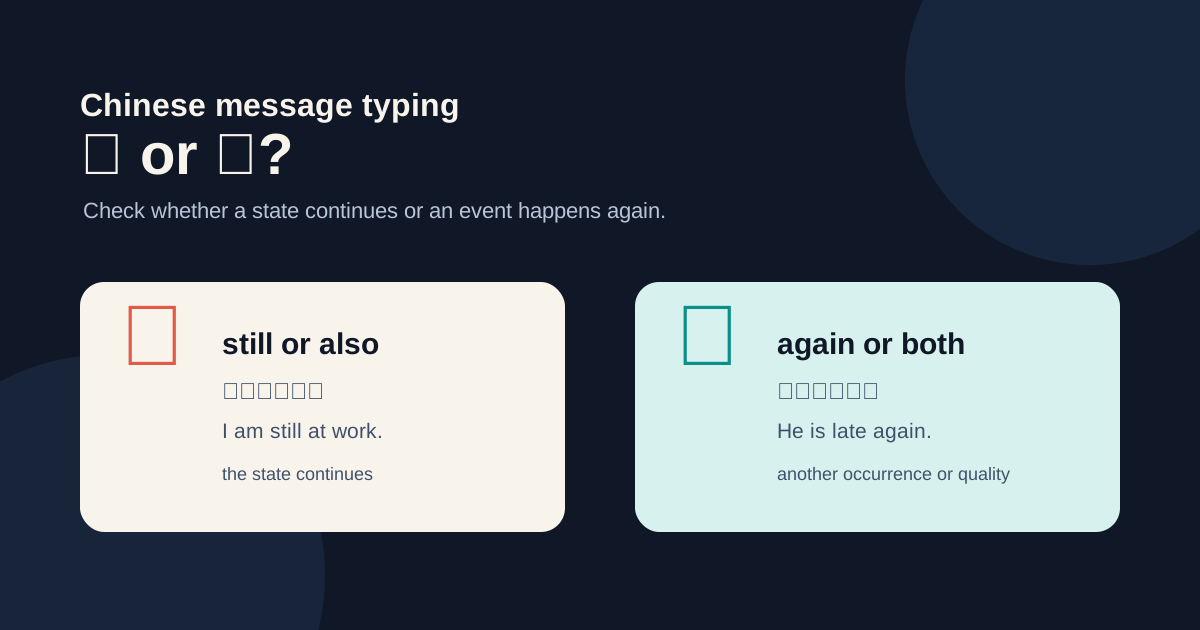
Use 还 for a state that continues, something that has not happened yet, or an additional item. Use 又 when an event happens again, or when two qualities belong to the same person or thing. Compare 我还在上班。 (I am still at work) with 他又迟到了。 (He is late again). For a future repeat, use 再: 我再试一次。 (I will try once more).
English translations such as "still," "also," and "again" overlap, so a Pinyin candidate list cannot choose for you. Look at the time of the action and the meaning of the whole message. This guide gives HSK 2 to 4 learners a sentence-level way to type 还, 又, and the nearby 再 pattern without treating them as interchangeable.
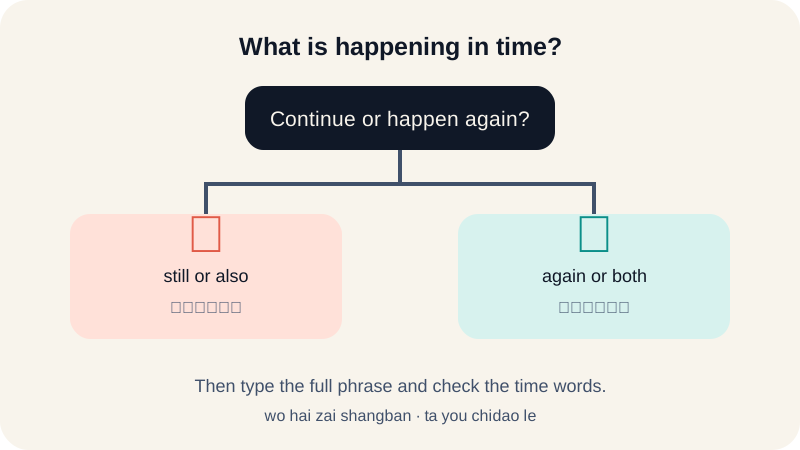
The short answer: continue or happen again?
| Message job | Useful learner default | Example | Meaning |
|---|---|---|---|
| Say a state continues | 还 | 我还在上班。 | I am still at work. |
| Say something has not happened yet | 还没 | 我还没吃饭。 | I have not eaten yet. |
| Add another item or action | 还 | 我还想喝茶。 | I also want tea. |
| Say an event happens again | 又 | 他又迟到了。 | He is late again. |
| Link two qualities | 又...又... | 她又高又瘦。 | She is both tall and thin. |
| Repeat something in the future | 再 | 我再试一次。 | I will try once more. |
These are useful learner defaults rather than translations that work in every context. 还 often keeps a state open or adds something to a list. 又 usually points to another occurrence or joins two descriptions. 再 commonly refers to a later or future repetition. The HSK syllabus helps you build a study set, while complete messages show which job the word has in context.
How to use 还 for still, yet, and also
Use 还 when a state continues at the time of the message:
我还在上班。(I am still at work.)你还在家吗?(Are you still at home?)他还没有回来。(He has not come back yet.)外面还很冷。(It is still cold outside.)
The pattern 还没 or 还没有 means that something has not happened yet. It keeps the action open, so 我还没看 means "I have not watched it yet." The 不 and 没 typing guide covers the negative markers that often appear after 还.
还 can also add another item, action, or wish:
我还想学汉字。(I also want to learn Hanzi.)请给我一杯茶,还要一杯水。(Please give me a cup of tea, and also a cup of water.)他会说中文,还会打字。(He can speak Chinese, and he can also type.)
In these examples, 还 does not mean that the first action is continuing. It adds one more fact to the conversation. Read the surrounding verb and object before selecting a character for hai.
How to use 又 for again and both...and
Use 又 when an event happens another time, often in a past or current situation:
他又迟到了。(He is late again.)今天又下雨了。(It rained again today.)我又忘了。(I forgot again.)她又回来了。(She came back again.)
The message usually assumes that the event happened before or was expected. 又 makes that repeated occurrence part of the meaning. It can be neutral, surprised, annoyed, or amused depending on the context and punctuation.
Use the pattern 又...又... when two qualities or actions apply to the same person or thing:
这家店又便宜又好吃。(This restaurant is both inexpensive and tasty.)他又会唱歌又会跳舞。(He can both sing and dance.)
This pattern connects two properties. It does not mean that one event happened twice. The AllSet Learning guide to 又 gives more examples of this repeated-event and paired-quality use.
还, 又, and 再 in one comparison
再 appears in the same learner questions because English often translates it as "again" too. A simple time check helps:
| Sentence | Time or meaning | Natural reading |
|---|---|---|
我还在看书。 | The activity continues now | I am still reading. |
我又看了一遍。 | The activity happened another time | I read it once again. |
我再看一遍。 | The speaker plans a later repetition | I will read it one more time. |
他还没来。 | Arrival has not happened yet | He has not arrived yet. |
他又来了。 | Arrival happened again | He came again. |
他再来一次。 | A later or requested repeat | He should come one more time. |
The boundary is a useful starting point, not a substitute for context. The 在 and 再 guide focuses on the characters 在 and 再; use it when the candidate window gives you the wrong character for a location or future-repeat sentence.
Some messages can contain more than one of these words:
我还要再看一遍。(I still want to read it one more time.)他又说要再试一次。(He again said that he would try once more.)
Each word keeps its own job. 还 adds or continues, 又 marks the repeated event, and 再 points to the later repeat.
A Pinyin candidate routine that works
The Ministry of Education Hanyu Pinyin scheme is the reference for the Romanization system. Type hai for 还, you for 又, and zai for 再, then include the surrounding phrase before selecting a Hanzi candidate.
- Identify the time: continuing now, repeated already, or planned for later.
- Check whether the word adds another item or joins two qualities.
- Type the complete phrase, such as
wo hai zai shangban,ta you chidao le, orwo zai shi yi ci. - Select the sentence from the candidate window instead of choosing a character after one syllable.
- Reread the time word, aspect marker, and punctuation before sending.
Apple's guide to using the Chinese candidate window on Mac explains how candidates are selected on macOS. Other keyboards use different layouts, but the sentence-level routine is the same. The 了, 过, and 着 guide gives more practice with aspect markers that can clarify whether an event has already happened.
A five-minute typing drill
Read the English meaning first. Type the Chinese sentence from memory, choose the candidates, and then label whether the word means continuing, adding, repeating, or planning a later repeat.
| Meaning | Target sentence | Pinyin input | Check |
|---|---|---|---|
| I am still at work. | 我还在上班。 | wo hai zai shangban | state continues |
| I have not eaten yet. | 我还没吃饭。 | wo hai mei chifan | action remains unfinished |
| He is late again. | 他又迟到了。 | ta you chidao le | repeated event |
| This shop is both cheap and tasty. | 这家店又便宜又好吃。 | zhe jia dian you pianyi you haochi | two qualities |
| I will try once more. | 我再试一次。 | wo zai shi yi ci | future repeat |
| He can also type. | 他还会打字。 | ta hai hui dazi | added ability |
After the first pass, change the time or aspect. Turn 我还在上班 into 我又上班了 and explain why the first sentence describes a continuing state while the second describes another work occurrence. Then change 我再试一次 into 我又试了一次 and notice how the planned repeat becomes a completed repeat.
For more real-message prompts, use the Chinese typing practice drills. The Mandarin sentence typing guide explains why a complete line gives you a better accuracy check than isolated character recall.
Mistakes to catch before sending
Using 又 for every English "again"
又 often describes a repeat that has happened or is happening. For a later repeat, 再 is usually the better learner choice: 我再看一次 means that the speaker will watch or read it again later. Check the time before selecting you or zai.
Using 还 when the event happened again
我还在等 means "I am still waiting." 我又等了一会儿 means "I waited for a while again." The first keeps the state open. The second reports another occurrence.
Missing 没 after 还
我还吃饭 does not clearly say "I have not eaten yet." Use 我还没吃饭 or 我还没有吃饭 when the action has not happened. Reread the negative marker after selecting the candidate.
Reading 又...又... as two repetitions
In 又高又瘦, the two 又 phrases give two descriptions of one person. They do not say that the person became tall twice or thin twice. Look for the paired adjective or verb pattern.
Choosing from a one-syllable candidate list
The sounds hai, you, and zai have several possible Hanzi candidates. Type ta you chidao le or wo hai mei chifan, then select the full phrase and reread it. A complete sentence gives the input method and your own eyes more context.
Treating the time rule as absolute
The continue, repeat, and future-repeat shortcut handles common HSK 2 to 4 messages. Fixed expressions, questions, tone, and longer clauses can change the reading. If a short message feels ambiguous, keep the time phrase visible and choose a complete sentence from a trusted reference.
Limits of this shortcut
These examples cover common messages for HSK 2 to 4 learners. 还 and 又 also have uses in comparisons, rhetorical questions, and structures where the English translation hides the Chinese relationship. The difference between an existing repetition and a planned repetition can depend on context.
When the meaning is uncertain, write the time in English first: still happening, happened again, or will happen again. Then type the full Chinese sentence. The 因为 and 所以 guide offers another example of using the complete clause relationship to choose a small word.
FAQ
What is the difference between 还 and 又?
还 often means that a state continues, an action has not happened yet, or an additional fact belongs in the message. 又 often says that an event happened another time or joins two qualities in 又...又.... Compare 我还在等 with 我又等了一会儿.
Does 还 mean "also"?
It can. 他还会打字 means that typing is an additional ability. In 我还在上班, the same character means "still." The following words and the conversation tell you whether 还 continues a state or adds another fact.
Should I use 又 or 再 for "again"?
Use 又 for an event that happened again or is happening again, such as 他又迟到了. Use 再 for a later, planned, or requested repeat, such as 请再说一次. The 在 and 再 guide has more examples of 再 in messages.
What does 还没 mean?
还没 means "not yet." 我还没吃饭 says that eating has not happened up to now. The action may happen later, so the phrase leaves that possibility open.
What does 又...又... mean?
It links two qualities or actions that apply to the same person or thing. 这家店又便宜又好吃 means that the restaurant is both inexpensive and tasty. It describes two properties rather than two repetitions.
How do I type 还, 又, and 再 in Pinyin?
Type hai for 还, you for 又, and zai for 再. Include surrounding words before selecting a candidate, such as wo hai zai shangban or ta you chidao le, then check the time meaning and punctuation.