How to Type 一边...一边... in Chinese Messages
MandarinReps
10/29/2026
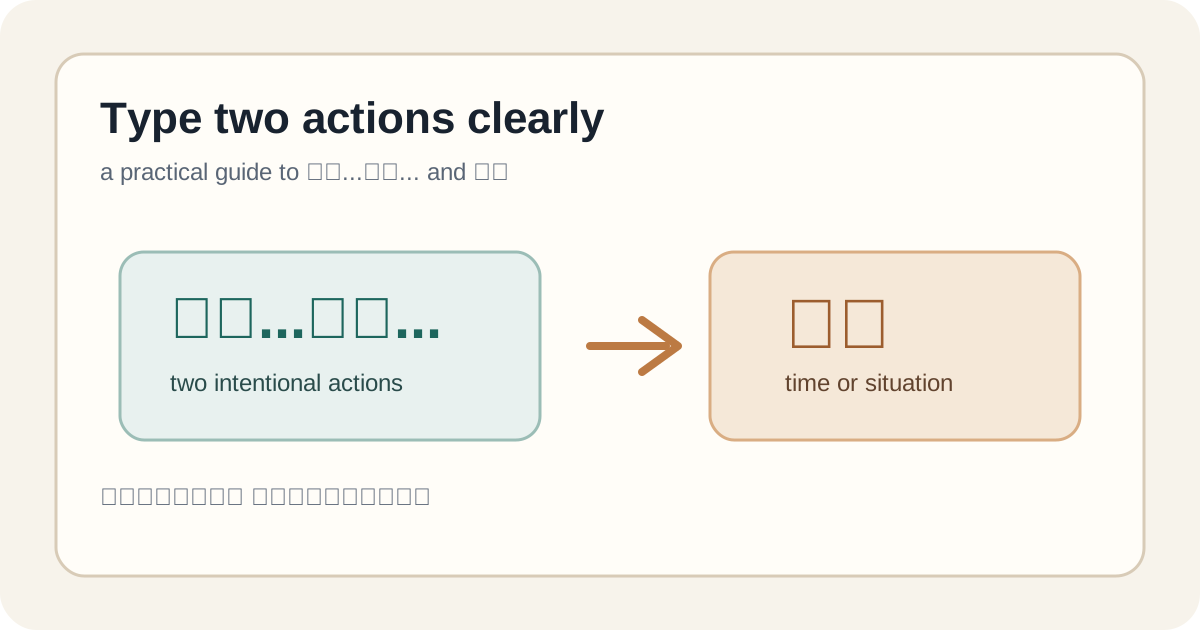
Use 一边...一边... (yībiān...yībiān...) when one person intentionally does two actions at the same time. The basic pattern is Subject + 一边 + Verb 1 + 一边 + Verb 2, as in 我一边走一边聊 (I walk while I talk). Use 的时候 when you mean that one event happens during another time or situation, as in 我吃饭的时候看手机 (I look at my phone while I eat).
That small distinction helps you choose the right Hanzi after typing yibian or de shihou. In a real message, first decide whether you are pairing two deliberate actions or locating an event in time. Then type the complete sentence and choose the candidate that matches the pattern.
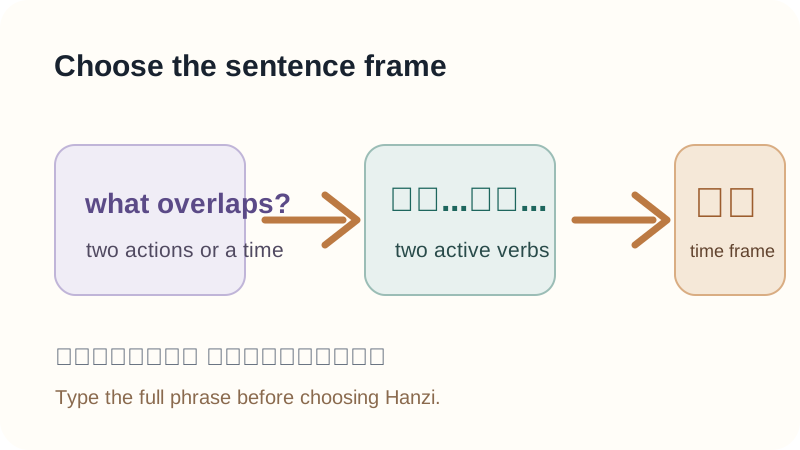
Choose 一边...一边... for two actions done together. Choose 时候 when the sentence needs a time or situation frame.
The short answer: 一边...一边... pairs two actions
The most useful message pattern is:
Subject + 一边 + Verb 1 + 一边 + Verb 2
Examples:
我一边走一边聊。(I walk while I talk.)她一边做饭一边听音乐。(She cooks while she listens to music.)我们一边吃饭一边说。(We eat while we talk.)
The two verbs describe actions that overlap. The subject normally stays at the beginning, so the sentence is easy to type as one complete unit. The Chinese Grammar Wiki describes this pattern as referring to simultaneous events and lists it at A2 and HSK 3 levels. Its examples also show that both actions are intentional, such as walking and chatting or reading and writing. See the Chinese Grammar Wiki entry for simultaneous tasks with 一边 for the original grammar examples.
| Message job | Pattern | Example | Meaning |
|---|---|---|---|
| Pair two actions | Subject + 一边 + V + 一边 + V | 我一边走一边聊。 | I walk while I talk. |
| Describe a habit | Subject + 常常 + 一边 + V + 一边 + V | 我常常一边听歌一边学习。 | I often study while listening to music. |
| Give a request | 别 or 不要 + 一边 + V + 一边 + V | 不要一边吃饭一边看手机。 | Do not look at your phone while eating. |
| Make a suggestion | 我们 + 一边 + V + 一边 + V + 吧 | 我们一边走一边聊吧。 | Let us walk and talk. |
Put 一边 before each verb
Type 一边 before both actions. The first 一边 introduces the first verb, and the second one introduces the action happening alongside it:
我一边看书一边喝茶。(I read while drinking tea.)你可以一边听一边写。(You can listen while writing.)他一边等车一边回消息。(He waits for the bus while replying to messages.)
The pattern works well in study and coordination messages because the reader can see both activities. Add a modal or frequency word before the first 一边 when needed:
我想一边练习一边记生词。(I want to practise while memorising new words.)她常常一边上班一边学中文。(She often studies Chinese while working.)
When both actions have the same subject, keep one subject at the beginning. You do not need to repeat 我, 她, or 我们 before the second verb. The repeated 一边 is the signal that the actions share the same time frame.
When should you use 时候 instead?
Use 的时候 when one action or event happens during a time, activity, or situation. The focus is the time frame, not a pair of equally active tasks:
我吃饭的时候看手机。(I look at my phone when I eat.)你学习的时候可以听音乐吗?(Can you listen to music when you study?)我到家的时候给你发消息。(I will message you when I get home.)
The Chinese Grammar Wiki page for 时候 links 的时候 to the grammar pattern for expressing "when." It is useful when the first clause names the time or situation in which the second event occurs.
Compare the message job before typing:
| If you mean... | Use... | Example | Why |
|---|---|---|---|
| Two actions overlap on purpose | 一边...一边... | 我一边走一边听。 | Walking and listening are paired activities. |
| One event happens during a situation | 的时候 | 我走路的时候听音乐。 | Walking provides the time frame for listening. |
| A warning about two simultaneous actions | 不要一边...一边... | 不要一边开车一边打电话。 | The sentence warns against doing both actions together. |
| A future time reference | ...的时候 | 你到家的时候告诉我。 | Arriving home is the time for the next action. |
English often uses "while" for all of these sentences. Chinese gives you a useful choice: pair two deliberate actions with 一边...一边..., or put an event inside a time frame with 的时候.
Type the complete phrase in a Pinyin IME
The Ministry of Education describes Hanyu Pinyin as a tool used in learning, information processing, and communication. That makes Pinyin useful for sentence output, but the keyboard still gives you Hanzi candidates rather than a finished grammar decision. Apple's Chinese input guide explains that the candidate window shows possible characters and relevant predictions for the input code.
Use this five-step routine:
- Decide whether the sentence pairs two intentional actions or names a time frame.
- Type the whole phrase, such as
wo yi bian zou yi bian liao. - Select
一边from the candidate window, then continue typing the next phrase. - Read the sentence once to check that both verbs match the intended subject.
- Read it again as a message recipient and check whether it sounds like a habit, request, or plan.
Typing only yibian gives the input method little sentence context. Typing wo yi bian ting yinyue yi bian zuo zuoye lets you practise the full sequence and check the two actions together. The wrong-character guide explains why longer word boundaries often help when the candidate list is noisy.
Common mistakes in Chinese messages
Using one 一边 for two actions
我一边走聊天 is hard to read because the second action has no matching marker. For the standard pattern, type 我一边走一边聊天 or the shorter 我一边走一边聊.
Using 一边 for an event that is only a time frame
When you mean "when I get home," use 我到家的时候给你发消息. The phrase 到家 identifies the time of the message. It is not a second activity that you are deliberately doing alongside another activity.
Repeating the subject unnecessarily
我一边看书我一边喝茶 has an extra subject in the middle. Use 我一边看书一边喝茶. Repeating the subject can change the sentence structure, so check the first draft before selecting more candidates.
Pairing actions with different subjects
The basic pattern is clearest when both verbs belong to the same subject. If two people act at the same time, write two clauses instead:
我在做饭,他在洗碗。(I am cooking, and he is washing the dishes.)
The guide to 在 and 再 can help when you need to type 在 for an ongoing action or location.
A five-minute typing drill
Read the prompt, type the Chinese sentence from memory, then label the sentence as a pair of actions or a time frame. Keep the Pinyin in your practice notes only long enough to check the candidate selection.
| English prompt | Target sentence | Pinyin input | Check |
|---|---|---|---|
| I walk while I listen to music. | 我一边走一边听音乐。 | wo yi bian zou yi bian ting yinyue | two actions |
| She cooks while listening to music. | 她一边做饭一边听音乐。 | ta yi bian zuofan yi bian ting yinyue | two actions |
| Please listen while you write. | 请一边听一边写。 | qing yi bian ting yi bian xie | request |
| I message you when I get home. | 我到家的时候给你发消息。 | wo dao jia de shi hou gei ni fa xiaoxi | time frame |
| Do not look at your phone while driving. | 不要一边开车一边看手机。 | bu yao yi bian kaiche yi bian kan shouji | warning |
| Tell me when you have time. | 你有时间的时候告诉我。 | ni you shijian de shi hou gaosu wo | time frame |
On the second pass, change one verb while keeping the structure. Turn 我一边走一边听音乐 into 我一边走一边复习生词. Turn 我到家的时候给你发消息 into 我下课的时候给你发消息. This keeps the grammar visible while you build useful vocabulary.
For more sentence-level practice, use the real-message typing drills. The guide to 吗, 呢, and 吧 also covers 吧 when you want to turn a paired-action sentence into a suggestion.
FAQ
What does 一边...一边... mean?
一边...一边... means that the same subject does two actions at the same time. The common pattern is Subject + 一边 + Verb 1 + 一边 + Verb 2, as in 我一边走一边聊.
Is 一边...一边... the same as 时候?
They can both translate as "while," but their jobs differ. 一边...一边... pairs two intentional activities. 的时候 names the time or situation in which another event happens.
Do I need to type 一边 twice?
Use the repeated form for the standard pattern: 一边读一边写. In casual speech and writing, you may also see 边读边写, which is shorter. The repeated form is easier for learners to recognise and practise.
Can 一边...一边... describe a habit?
Yes. Add a frequency word when useful, as in 我常常一边听歌一边学习 (I often study while listening to music). The pattern still pairs two activities done by the same subject.
Can the two actions have different subjects?
The basic pattern is clearest with one subject doing both actions. If two people act at the same time, write separate clauses so the reader can see who does what.
How do I type 一边 with Pinyin?
Type yi bian inside the complete phrase, such as wo yi bian zou yi bian liao, then choose 一边 from the candidate window. The Chinese punctuation guide can help you finish the message with the correct Chinese full stop or question mark.
Limits of this shortcut
This guide covers the common HSK 2 to 4 message pattern. A sentence can need a different connector when the actions have different subjects, when one event interrupts another, or when the timing matters more than simultaneous activity. In those cases, write the two clauses clearly and use a time expression such as 的时候.
For routine practice, start with the meaning, type the full phrase, choose the Hanzi candidates, and check the final sentence. That routine turns yibian from an isolated Pinyin string into a usable message pattern.