How to Type 也 and 都 in Chinese Messages
MandarinReps
10/10/2026
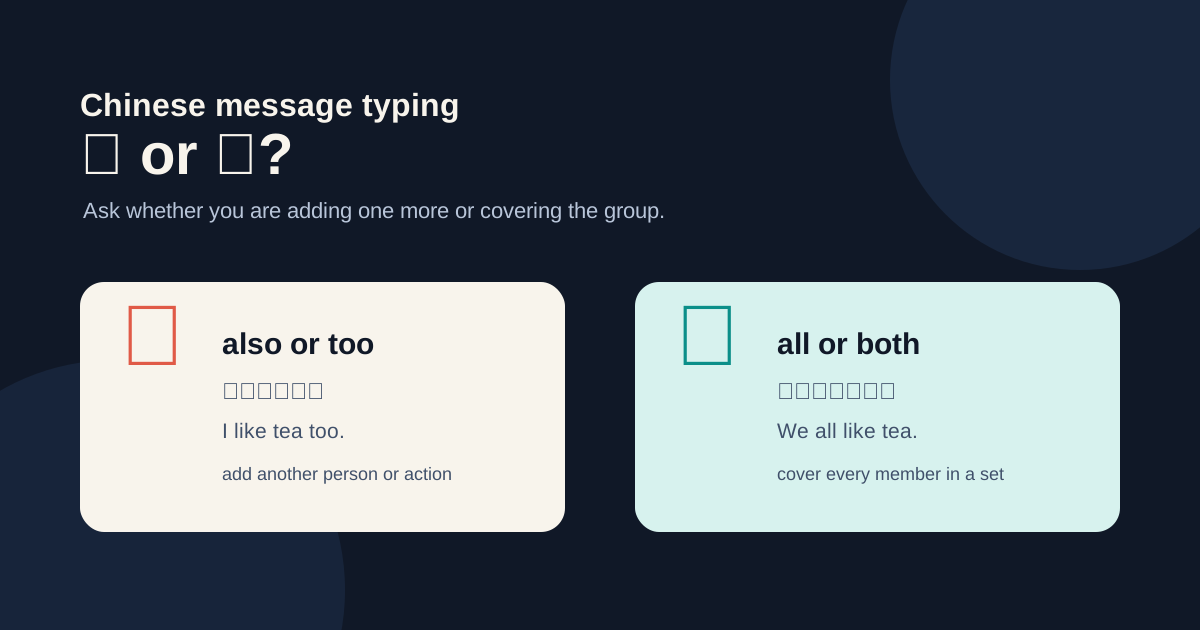
Use 也 when you add another person, action, or property. Use 都 when the sentence covers every person or item in a group, including both members of a pair. Compare 我也喜欢茶。 (I like tea too) with 我们都喜欢茶。 (We all like tea). The subject and the size of the group decide which character belongs in the message.
也都 can be correct when both ideas are present: 我们也都喜欢茶。 means that we also all like tea. The first word adds this group or fact to the conversation. The second word says that every member of the group has the same property. This guide gives HSK 2 to 4 learners a sentence-level way to type the right character and reread a message before sending it.
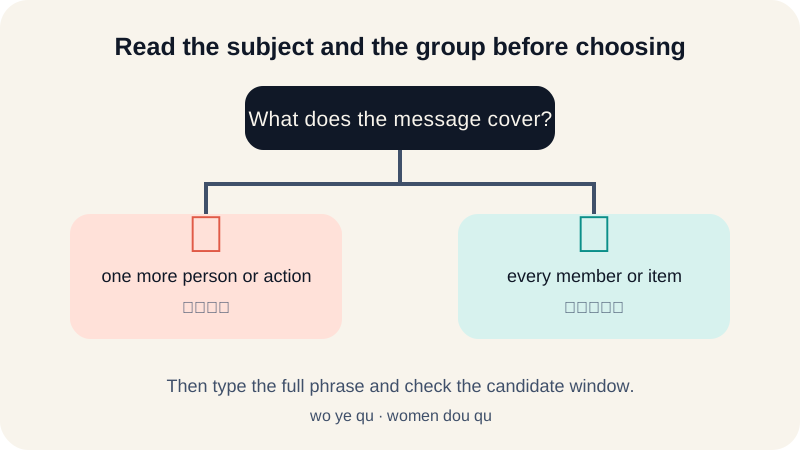
The short answer: add one more or cover the group?
| Message job | Useful learner default | Example | Meaning |
|---|---|---|---|
| Add another person or action | 也 | 我也去。 | I am going too. |
| Add another property | 也 | 她也会中文。 | She also knows Chinese. |
| Cover two named people | 都 | 我和他都去。 | He and I are both going. |
| Cover everyone in a group | 都 | 大家都到了。 | Everyone has arrived. |
| Add a group that is also included | 也都 | 我们也都想去。 | We all want to go too. |
These are useful learner defaults rather than translations that work in every sentence. 也 points to an additional item in the conversation. 都 looks back to a plural subject, a pair, or a group and says that the predicate applies across that set. The HSK syllabus is useful for building a study list, but the completed sentence still needs to carry the meaning.
How to use 也 for "also" and "too"
Use 也 when the message adds a second person, action, or description:
我也想学中文。(I also want to learn Chinese.)他也会打字。(He can type too.)今天也很冷。(It is cold today too.)我也喜欢这个电影。(I like this film too.)
In a simple clause, 也 usually comes after the subject or topic and before the verb or adjective. It can appear before a negative marker in patterns such as 我也不去 (I am not going either) and 她也没来 (She did not come either). The word often refers back to something already mentioned. Without that earlier comparison, a reader may wonder what 也 is adding.
也 does not mean that every member of a group does something. 他们也喜欢茶 says that they like tea too, perhaps along with another person or group. It does not by itself make the sentence mean that every person in the group likes tea. If you need that whole-group reading, 他们都喜欢茶 is the clearer choice.
How to use 都 for "all" and "both"
Use 都 when a plural subject or named pair shares the same action or quality:
我们都要上班。(We all have to work.)我和她都去了。(She and I both went.)他们都喜欢中文。(They all like Chinese.)这些字我都认识。(I know all of these characters.)
In common learner sentences, 都 comes after the plural subject or topic and before the verb, adjective, or other predicate. Compare 我和他都去 with 我也去. The first names two people and includes both of them. The second adds the speaker to a plan that someone else has already mentioned.
都 can describe a pair even when the English translation uses "both": 你们两个都可以。 means both of you can do it. It does not mean "always" in these examples. Time, aspect, and context still come from the rest of the sentence, as in 他们昨天都来了 (they all came yesterday).
With a negative, 都不 or 都没 commonly gives a whole-group reading:
我们都不喝咖啡。(None of us drink coffee.)他们都没来。(None of them came.)
This is different from 也不 or 也没, which usually means "not either" and connects the subject to a previous person or action. The 不 and 没 typing guide gives more practice with those negative patterns.
When 也 and 都 appear together
The two characters answer different questions, so they can share a sentence:
你们也都喜欢吗?(Do you all like it too?)他们也都想去。(They all want to go too.)我们也都不认识他。(None of us know him either.)
Here 也 adds this group or fact to the conversation. 都 distributes the action or description across every member of the group. Remove one word and the meaning changes:
| Sentence | What it adds | Natural reading |
|---|---|---|
我也喜欢。 | The speaker joins an existing preference | I like it too. |
我们都喜欢。 | Every member of "we" has the preference | We all like it. |
我们也都喜欢。 | This group is also included, and every member agrees | We all like it too. |
他们也不去。 | They will not go either | They join an earlier negative plan. |
他们都不去。 | No member of the group will go | None of them are going. |
Do not add 都 merely because the English sentence contains "also." Do not add 也 merely because the subject is plural. Decide whether the message is adding a comparison, covering a set, or doing both.
A Pinyin candidate routine that works
The Ministry of Education Hanyu Pinyin scheme is the reference for the Romanization system. Your input method maps ye and dou to candidate Hanzi, but it cannot infer whether the sentence adds one more person or covers every person in a group.
- Read the whole sentence and underline the subject or topic.
- Ask whether the message adds another item, covers the set, or does both.
- Type the complete phrase, such as
wo ye qu,women dou qu, ornimen ye dou xihuan ma. - Select the full phrase from the candidate window instead of choosing a character after typing only
yeordou. - Reread the subject, negative marker, and punctuation before sending.
Apple's guide to using the Chinese candidate window on Mac explains how candidates are selected on macOS. Other keyboards use different layouts, but the sentence-level routine is the same. The 会, 能, and 可以 guide shows why surrounding words give an input method better information than one syllable alone.
A five-minute typing drill
Read the English meaning first. Type the Chinese sentence from memory, choose the candidates, and then explain why the sentence uses 也, 都, or 也都.
| Meaning | Target sentence | Pinyin input | Reason |
|---|---|---|---|
| I also want to learn Chinese. | 我也想学中文。 | wo ye xiang xue zhongwen | add the speaker to an existing desire |
| He can type too. | 他也会打字。 | ta ye hui dazi | add another person's ability |
| We all have to work. | 我们都要上班。 | women dou yao shangban | cover every member of the group |
| She and I both went. | 我和她都去了。 | wo he ta dou qu le | cover two named people |
| Do you all like it too? | 你们也都喜欢吗? | nimen ye dou xihuan ma | add this group and cover everyone in it |
| None of them drink coffee. | 他们都不喝咖啡。 | tamen dou bu he kafei | negative applies to the whole group |
After the first pass, change one detail and type the sentence again. Turn 我也去 into 我们都去 and explain why the subject changes the job of the small word. Then turn 他们都不喝咖啡 into 他们也不喝咖啡 and imagine the previous sentence that makes the second version natural.
For more real-message prompts, use the Chinese typing practice drills. The Mandarin sentence typing guide explains why a complete line gives you a better accuracy check than isolated character recall.
Mistakes to catch before sending
Using 都 for "too"
都 does not simply translate every English use of "too." 我也去 means the speaker is going in addition to someone or something already mentioned. 我们都去 means the whole group is going. Look at the subject before selecting the character.
Using 也 for everyone
他们也喜欢 adds them to an existing comparison. 他们都喜欢 says that the members of that group share the preference. If you want both meanings, use 他们也都喜欢 when the context supports it.
Putting 都 next to the wrong subject
For a basic learner pattern, keep 都 after the plural subject or topic: 我和他都认识 and 大家都知道. This makes the group visible before the sentence states what applies to it.
Reading 也都 as one fixed word
也都 is not a single vocabulary item that replaces either character. It is the combination of "also" and "all." Keep both only when the message needs both meanings.
Choosing from a one-syllable candidate list
The sounds ye and dou have other candidates and uses. Type women dou yao shangban or nimen ye dou xihuan ma, then select the phrase and reread the result. Full-sentence typing is also a useful way to catch a wrong subject or missing negative marker.
Limits of this shortcut
The patterns here cover common HSK 2 to 4 messages. 也 and 都 also appear in comparisons, idioms, and longer sentences where word order needs separate study. Treat these examples as a first check rather than a complete grammar description.
When your intended meaning feels uncertain, write the subject and comparison in English first. Then type a complete Chinese sentence and compare it with a dictionary or class reference. The 还是 and 或者 guide gives another example of how a small word choice changes a question.
FAQ
Can 也 and 都 replace each other?
Usually not. 也 adds another person, action, or property. 都 says that every member of a named group or pair shares the predicate. 我也去 and 我们都去 can describe a similar event, but they organize the participants differently.
What is the difference between 我也去 and 我们都去?
我也去 means the speaker is going too, usually because another person or plan is already in the conversation. 我们都去 means everyone included in 我们 is going. The first focuses on addition. The second covers the group.
Why can 也 and 都 appear together?
They contribute separate meanings. In 我们也都想去, 也 adds this group to the discussion and 都 says every member of the group wants to go. If only one meaning is needed, remove the other word.
What is the difference between 都不 and 也不?
都不 normally applies a negative action to the whole group: 我们都不去 means none of us are going. 也不 usually means "not either" and connects the subject to a previous negative statement: 我们也不去 means we are not going either. Context matters, but the group-versus-addition distinction is a useful first check.
Does 都 mean "always"?
No. In 他们都来了, 都 covers every person in 他们. It does not say that they come all the time. Words such as 每天 or 总是 express recurring time or frequency.
How do I type 也 and 都 in Pinyin?
Type ye for 也 and dou for 都, then include the surrounding words before selecting a candidate. For example, type wo ye qu for 我也去 and women dou qu for 我们都去. Read the subject and predicate once more before sending.