How to Type 要 and 想 in Chinese Messages
MandarinReps
10/9/2026
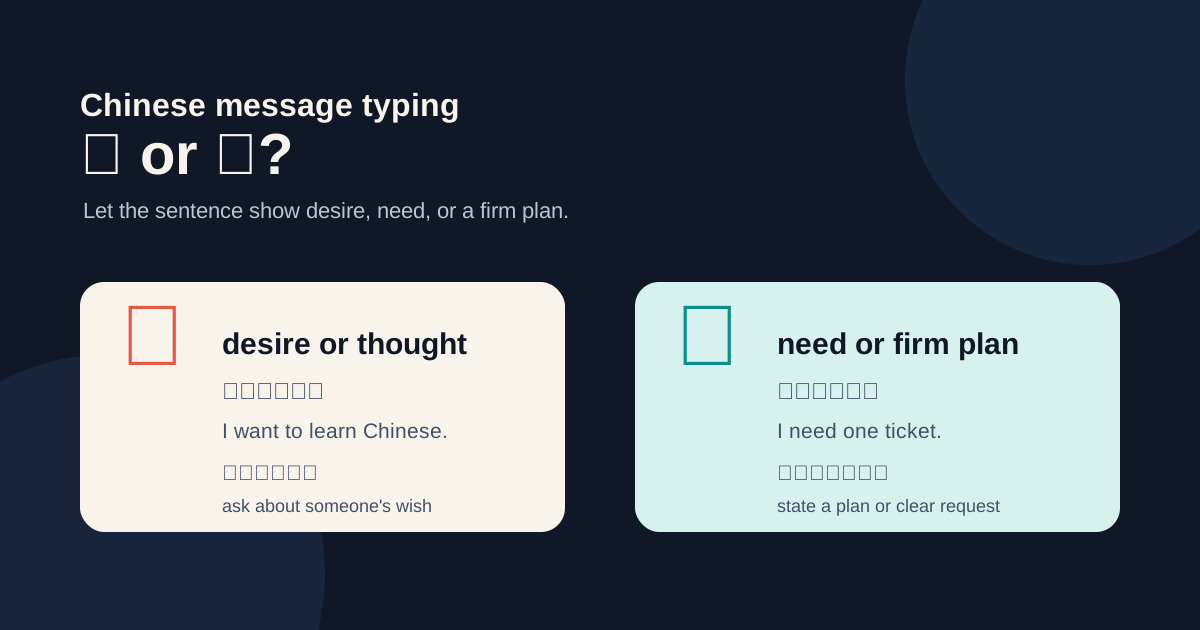
Use 想 when the message expresses a desire, a thought, or something a person is considering. Use 要 when the message states a need, a clear request, or a firm plan. Compare 我想喝茶。 (I want to drink tea) with 我要喝茶。 (I want tea, or I am going to drink tea). Both can be correct. The situation and tone decide which one fits.
English often translates both words as "want," so the Pinyin candidate window cannot choose for you. The surrounding verb, noun, time phrase, and question pattern carry the meaning. This guide gives HSK 2 to 4 learners a sentence-level way to type the right character and reread a message before sending it.
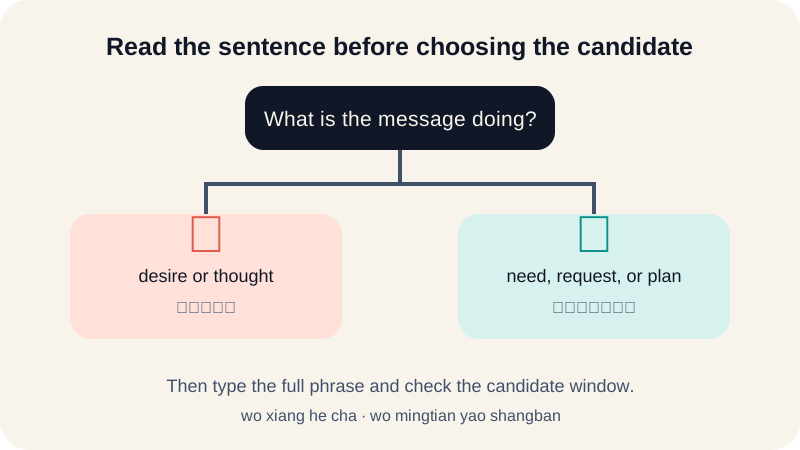
The short answer: desire or commitment?
| Message job | Useful learner default | Example | Meaning |
|---|---|---|---|
| Expressing a desire | 想 | 我想学中文。 | I want to learn Chinese. |
| Asking about desire | 想不想 | 你想不想去? | Do you want to go? |
| Asking whether someone wants an option | 要不要 | 你要不要喝茶? | Do you want tea? |
| Requesting or ordering something | 要 | 我要一张票。 | I need one ticket. |
| Stating a firm plan or requirement | 要 | 我明天要上班。 | I have to work tomorrow. |
| Asking politely about a wish | 想要 | 我想要一杯水。 | I would like a glass of water. |
These are useful learner defaults rather than rigid translations. 要 can express a future event, a requirement, a request, or a strong choice. 想 can express desire or thought, and context can make a wish sound very definite. The HSK syllabus helps you build a study set, but each sentence still needs its own context.
How to use 想 for desire and thought
Use 想 + verb when someone wants to do something or is considering it:
我想吃面。(I want to eat noodles.)她想去上海。(She wants to go to Shanghai.)你想看电影吗?(Do you want to watch a film?)我想问一下老师。(I would like to ask the teacher.)
The question pattern 想不想 asks directly about desire: 你想不想一起去? means "Do you want to go together?" It gives the other person room to answer about what they want. In a message about plans, 我想明天去 can sound like an intention or a plan under consideration. The exact strength comes from the surrounding conversation.
Use 想要 + noun when the object is the thing someone wants:
我想要一杯水。(I would like a glass of water.)孩子想要这个玩具。(The child wants this toy.)我想要一个安静的房间。(I want a quiet room.)
想 also has a thought meaning in patterns such as 我想他在家。 (I think he is at home.) and 我想知道答案。 (I want to know the answer.) When typing xiang, read the whole clause before choosing a candidate. The character may be correct while your intended sentence meaning is different.
How to use 要 for needs, requests, and plans
Use 要 + noun when the message asks for or identifies something needed:
我要一张票。(I need one ticket.)他要一杯咖啡。(He wants a cup of coffee.)我们要两个房间。(We need two rooms.)
In a shop or service message, 我要... is a clear order. It can sound direct, which may be appropriate when you are stating exactly what you need. 我想要... frames the same object as a wish or request. Neither form is automatically rude. The relationship, situation, and added words such as 请 still shape the tone.
Use 要 + verb for a firm plan, a requirement, or an event that is about to happen:
我明天要上班。(I have to work tomorrow.)我们八点要开会。(We have a meeting at eight.)我现在要走了。(I am leaving now.)快要下雨了。(It is about to rain.)
The question pattern 要不要 asks whether someone wants, accepts, or plans to take an option: 你要不要一起吃饭? can mean "Do you want to eat together?" or "Shall we eat together?" It is a common message pattern for offers and decisions.
Compare the pairs before you press send
| Sentence | What it emphasizes | Natural reading |
|---|---|---|
我想去北京。 | A wish or intention | I want to go to Beijing. |
我明天要去北京。 | A firm plan | I am going to Beijing tomorrow. |
我想喝茶。 | A desire | I would like tea. |
我要喝茶。 | A clear choice or order | I want tea. |
你想不想看电影? | The other person's desire | Do you want to watch a film? |
你要不要看电影? | An offer or decision | Do you want to watch a film? |
我想问一下。 | A wish to ask | I would like to ask something. |
我有一个问题要问。 | A task that needs to happen | I have a question to ask. |
The English translations overlap because the Chinese distinction is about stance and situation. Use 想 when you are describing what is in someone's mind. Use 要 when the message moves toward a need, a decision, or an expected action.
A Pinyin candidate routine that works
The Ministry of Education Hanyu Pinyin scheme is the reference for the Romanization system. Your input method then maps the letters to candidate Hanzi. It cannot infer whether yao means a request, a plan, or another word, and it cannot infer whether xiang means want or think.
- Read the whole sentence and identify whether it expresses desire, thought, need, or commitment.
- Type the surrounding phrase, such as
wo xiang he cha,wo mingtian yao shangban, orni yao bu yao he cha. - Select the complete phrase from the candidate list. Do not choose a character after typing only
yaoorxiang. - Reread the subject, time word, verb, and punctuation before sending.
Apple's guide to using the Chinese candidate window on Mac explains how candidates are selected on macOS. Other keyboards use different layouts, but the sentence-level routine is the same. The 会, 能, and 可以 guide shows why the surrounding sentence gives an input method better information than one syllable alone.
A five-minute typing drill
Read the English meaning first. Type the Chinese sentence from memory, choose the candidates, and then explain why the sentence uses 想, 要, 想不想, or 要不要.
| Meaning | Target sentence | Pinyin input | Reason |
|---|---|---|---|
| I want to learn Chinese. | 我想学中文。 | wo xiang xue zhongwen | desire |
| I have to work tomorrow. | 我明天要上班。 | wo mingtian yao shangban | firm plan or requirement |
| Do you want to go together? | 你想不想一起去? | ni xiang bu xiang yiqi qu | asks about desire |
| Do you want to drink tea? | 你要不要喝茶? | ni yao bu yao he cha | offer or decision |
| I would like a glass of water. | 我想要一杯水。 | wo xiang yao yi bei shui | wish or request |
| I need one ticket. | 我要一张票。 | wo yao yi zhang piao | clear need or order |
After the first pass, change one detail and type the sentence again. Turn 我想去北京 into 我明天要去北京 and explain how the message moves from a wish to a firm plan. Turn 你想不想喝茶? into 你要不要喝茶? and notice how the second version sounds more like an offer or decision.
For more real-message prompts, use the Chinese typing practice drills. The Mandarin sentence typing guide explains why a complete line gives you a better accuracy check than isolated character recall.
Mistakes to catch before sending
Translating every "want" as 想
想 fits a desire, while 要 may fit a need or a clear order. In a shop, 我要一杯茶 is a normal way to state the order. In a message about what you hope to do, 我想喝茶 describes the wish. Read the situation before choosing.
Treating 我要 as rude in every situation
我要 can be direct, but directness is not the same as rudeness. It works for a clear order, a requirement, or a firm plan. Add 请, a question pattern, or 我想要 when the message needs a softer request. The relationship and setting still matter.
Using 要不要 when you mean someone's inner wish
你想不想学中文? asks whether the person wants to learn Chinese. 你要不要学中文? can ask whether they will take the option or commit to it. Both can be natural, but the second points more toward a decision.
Confusing 不想, 不要, and 不用
我不想去 means "I do not want to go." 不要去 means "Do not go." 不用去 means "There is no need to go." The 不 and 没 guide covers the negative patterns that sit behind these expressions.
Typing only yao or xiang
The sounds have several candidates. Type wo xiang yao yi bei shui or wo mingtian yao shangban, then select the phrase and read it again. The full sentence helps you notice whether the message expresses a wish, a need, or a plan.
Limits of this shortcut
The patterns here cover common HSK 2 to 4 messages. 要 and 想 also appear in longer structures, fixed expressions, and speech styles that need separate study. A short message can be understood with either word when the context supplies the missing meaning.
When your intended tone still feels uncertain, keep the surrounding words visible and compare a complete example in a dictionary or class reference. The 还是 and 或者 guide gives another example of how a small word choice changes the job of a question.
FAQ
Can 要 and 想 replace each other?
Sometimes, especially when both sentences describe a desire. 我想喝茶 and 我要喝茶 can both be understood, but the first foregrounds a wish and the second sounds more like a clear choice, order, or intention. Context decides the better fit.
Does 我要 always sound rude?
No. 我要一张票 is a normal clear order. In a sensitive request, 我想要一张票 or 请给我一张票 may sound softer. The words around 要 and the relationship between speakers affect the tone.
What is the difference between 想不想 and 要不要?
想不想 asks about desire: 你想不想去? asks whether someone wants to go. 要不要 asks about taking an option or making a choice: 你要不要去? can mean "Are you going?" or "Do you want to go?" The context supplies the exact reading.
Can 想 mean "think"?
Yes. In 我想他在家, 想 means "think" or "suppose." In 我想学中文, it means "want to." The following words and clause pattern tell you which meaning is active.
What is 不要 compared with 不想 and 不用?
不要 gives a negative instruction, 不想 states that someone does not want to do something, and 不用 says that an action is unnecessary. For example, 不要说话 means "Do not speak," 我不想说话 means "I do not want to speak," and 你不用说 means "You do not need to speak."
How do I type 要 and 想 in Pinyin?
Type yao for 要 and xiang for 想, then include the words around them before selecting a candidate. For example, type wo xiang he cha for 我想喝茶 and wo mingtian yao shangban for 我明天要上班. Read the completed sentence once before sending it.