How to Type 跟 and 和 in Chinese Messages
MandarinReps
10/30/2026
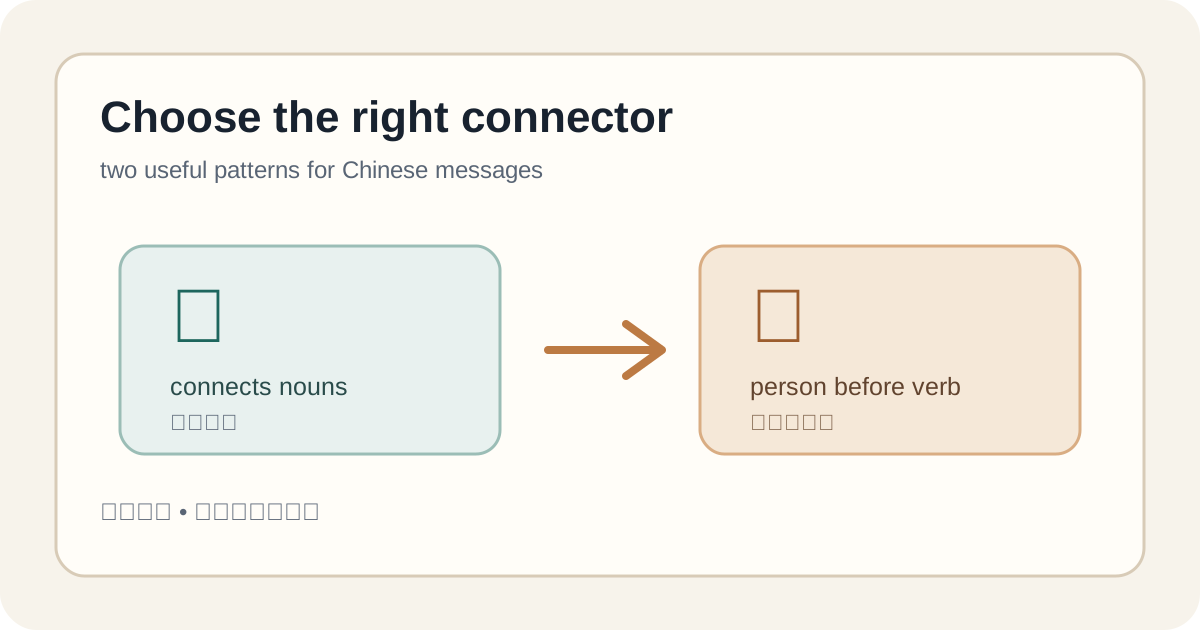
Use 和 (hé) mainly to join nouns in a list, such as 咖啡和茶 (coffee and tea). Use 跟 (gēn) when one person does something with another person before the verb, such as 我跟朋友去吃饭 (I am going to eat with a friend). In many everyday "with" messages, 跟 and 和 can both work, but 跟 is the clearest first choice when a person follows it.
That distinction gives you a useful typing decision: is hé joining things, or is gēn introducing the person who joins an action? Decide that before choosing a Hanzi candidate, then type the complete phrase rather than practising either character in isolation.
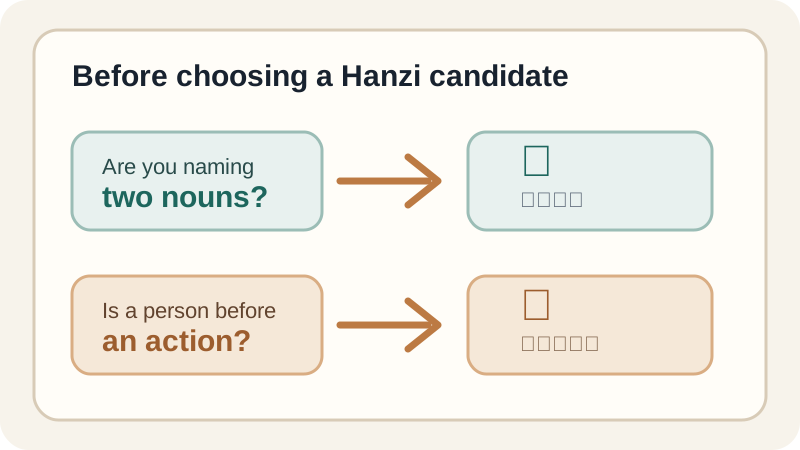
Choose 和 when the sentence connects nouns. Choose 跟 when a person comes before an action you do together.
The short answer: 和 joins nouns, 跟 introduces a person before a verb
The beginner-friendly patterns look like this:
| Message job | Pattern | Example | Meaning |
|---|---|---|---|
| Join items in a list | Noun 1 + 和 + Noun 2 | 咖啡和茶 | coffee and tea |
| Do an action with someone | Subject + 跟 + Person + Verb | 我跟朋友去吃饭。 | I eat with a friend. |
| Emphasise doing it together | Subject + 跟 + Person + 一起 + Verb | 我跟朋友一起学习。 | I study with a friend. |
| Meet or chat with someone | Subject + 跟 + Person + Verb | 我跟老师见面。 | I meet with my teacher. |
This is a practical starting point, not a rule that every sentence must obey. Chinese Grammar Wiki describes 和 as mainly linking nouns. Its guide to 跟 presents it as a common preposition for "with" and places the phrase before the verb. The same guide also notes that 跟 and 和 are interchangeable in many common "with" examples.
Use 和 to connect nouns in a list
When the sentence names two or more things, 和 usually does the connecting work:
我喜欢咖啡和茶。(I like coffee and tea.)手机和电脑都很贵。(Phones and computers are both expensive.)你要米饭和面条吗?(Do you want rice and noodles?)周末我买水果和面包。(I buy fruit and bread on the weekend.)
The useful shape is:
Noun 1 + 和 + Noun 2
The two sides of 和 should belong to the same list or comparison. They can be people, objects, places, or other nouns, as in 我和姐姐 (my older sister and I), 北京和上海 (Beijing and Shanghai), or 中文和英文 (Chinese and English).
In a longer message, keep the list visible before moving to the verb: 我今天要买水果和面包。 (I need to buy fruit and bread today.) Here, 水果和面包 is the shopping list. If you need to describe two actions, use separate clauses or a sequence connector such as 然后 (then) or 再 (and then). The guide to 在 and 再 gives more practice with that choice.
Use 跟 before the person you act with
Use 跟 when a person is part of the action that follows. The common pattern is:
Subject + 跟 + Person + Verb + Object
Examples:
我跟朋友去海边。(I go to the beach with a friend.)我跟同学一起练习。(I practise with a classmate.)她跟妈妈聊天。(She chats with her mother.)明天我跟新客户见面。(I meet with a new client tomorrow.)我想跟你说一件事。(I want to tell you something.)
Add 一起 when you want to make "together" explicit:
你想跟我一起去吗?(Do you want to go with me?)我们跟老师一起读。(We read together with the teacher.)
跟 and 一起 are not redundant. 跟 identifies the person who joins the activity. 一起 highlights that the activity is shared. In a short message, 我跟你去 and 我跟你一起去 are both useful, with the second one putting more attention on doing it together.
How to choose when English says "and" or "with"
English uses "and" for lists and "with" for a partner, but learners sometimes meet sentences where both Chinese characters seem possible. Use the noun or verb around the character to make the decision:
| If the next words are... | Start with... | Example | Why |
|---|---|---|---|
| Two items in one list | 和 | 书和笔 | It links nouns. |
| A person before an action | 跟 | 跟朋友学习 | It introduces the action partner. |
| A person plus together | 跟 ... 一起 | 跟同事一起吃饭 | It names the partner and shared action. |
| Two people as a subject | 和 or 跟, depending on the sentence | 我和姐姐去北京。 | The phrase can mean "my sister and I" as the subject. |
The last row needs attention. 我和姐姐去北京 is natural because 我和姐姐 is the joint subject: my sister and I go to Beijing. 我跟姐姐去北京 is also a useful "with someone" practice sentence. The source guide for 跟 recommends starting with 跟 for that meaning, while recognising that common examples often allow 和.
Type 跟 and 和 with a Pinyin input method
Hanyu Pinyin is used in learning, information processing, and online communication, according to a Ministry of Education reference. A Pinyin keyboard helps you enter the sounds, but the candidate list cannot decide whether your sentence means a list or a shared action.
On a Mac, Apple's Chinese input guide explains that the candidate window displays possible characters and relevant predictions. Use that window as a checkpoint rather than accepting the first character that looks familiar.
Try this routine:
- Read the English idea and circle the relationship: list or shared action.
- Type the full phrase in Pinyin, such as
wo gen pengyou liao tian. - Choose
跟for the person before聊天, then continue the sentence. - Type a list such as
kafei he chaand choose咖啡和茶. - Read the finished message once. Ask whether the character joins nouns or introduces a person before a verb.
Typing a complete phrase gives the input method more context than typing only gen or he. If the candidate window is noisy, the wrong-character guide explains why longer word boundaries and a final sentence check help.
Common mistakes in Chinese messages
Treating every "and" or "with" as one character
和 is a strong choice for lists, but it is not a universal replacement for 跟. Write 我跟朋友聊天 for "I chat with a friend," but use 咖啡和茶 when you are naming two drinks. The question is what relationship the sentence needs.
Forgetting 跟 with verbs such as 见面 and 聊天
The phrase 我明天跟老师见面 has a clear partner before the verb. The same structure works with 聊天 and 结婚. If your first draft leaves the partner floating at the end, rebuild the sentence as Subject + 跟 + Person + Verb and read it again.
A five-minute typing drill
Type each sentence from the English prompt. Before selecting Hanzi, label the bold relationship as a list or a shared action.
| English prompt | Target sentence | Pinyin input | Check |
|---|---|---|---|
| I like coffee and tea. | 我喜欢咖啡和茶。 | wo xihuan kafei he cha | noun list |
| I go with a friend. | 我跟朋友去。 | wo gen pengyou qu | person before verb |
| She chats with her mother. | 她跟妈妈聊天。 | ta gen mama liao tian | partner plus verb |
| We study with the teacher. | 我们跟老师一起学习。 | women gen laoshi yiqi xuexi | partner plus together |
| I need rice and noodles. | 我需要米饭和面条。 | wo xuyao mifan he miantiao | noun list |
| Do you want to meet with me? | 你想跟我见面吗? | ni xiang gen wo jianmian ma | 见面 takes a partner |
On the second pass, change only one element. Replace 朋友 with 同学, or replace 咖啡 with 果汁. Keep the connector and sentence shape stable instead of memorising six unrelated messages.
For more sentence-level typing, use the real-message typing drills. The guide to 吗, 呢, and 吧 can help when you turn 你想跟我去 into a question or suggestion. If you are working through other short message patterns, the guide to 会, 能, and 可以 covers another set of choices that English often compresses into one word.
FAQ
What is the difference between 跟 and 和?
和 mainly joins nouns in a list, as in 咖啡和茶. 跟 commonly introduces the person who joins an action, as in 跟朋友聊天. In many "with" examples, 跟 and 和 can both be used, so read the full phrase rather than translating one character in isolation.
Can 和 mean "with"?
Yes. 和 can appear in many sentences that mean doing something with another person, and the two characters are interchangeable in many common examples. For a beginner typing routine, start with 跟 when a person comes before a verb, then learn the common places where 和 is also natural.
Why do I use 跟 with 见面 and 聊天?
见面 and 聊天 describe actions involving another person. Put that person before the verb: 跟老师见面 or 跟朋友聊天. This is a useful pattern to practise because English may not show the same word order as clearly.
Do I need 一起 after 跟?
No. 我跟你去 is complete. Add 一起 when you want to stress that the activity is shared: 我跟你一起去. If the partner is already clear from the conversation, 我们一起去 may be enough.
How do I type 跟 and 和 in Pinyin?
Type gen for 跟 and he for 和, then choose the character from the candidate window. Practise the complete phrase, such as wo gen pengyou liao tian or wo xihuan kafei he cha, so the final sentence gives you a meaning check.
Limits of this shortcut
This guide covers the common message patterns that an HSK 2 to 4 learner can practise immediately. It does not cover every regional preference, literary use, or advanced clause structure. Some sentences need the wider context to decide between 跟 and 和, especially when a phrase can be read as a joint subject or as a partner before the verb.
The useful habit is small: identify the relationship, type the complete phrase, choose the Hanzi candidate, and reread the message. With 和, check the list. With 跟, check the person and the following action.