How to Type 刚 and 刚才 in Chinese Messages
MandarinReps
10/25/2026
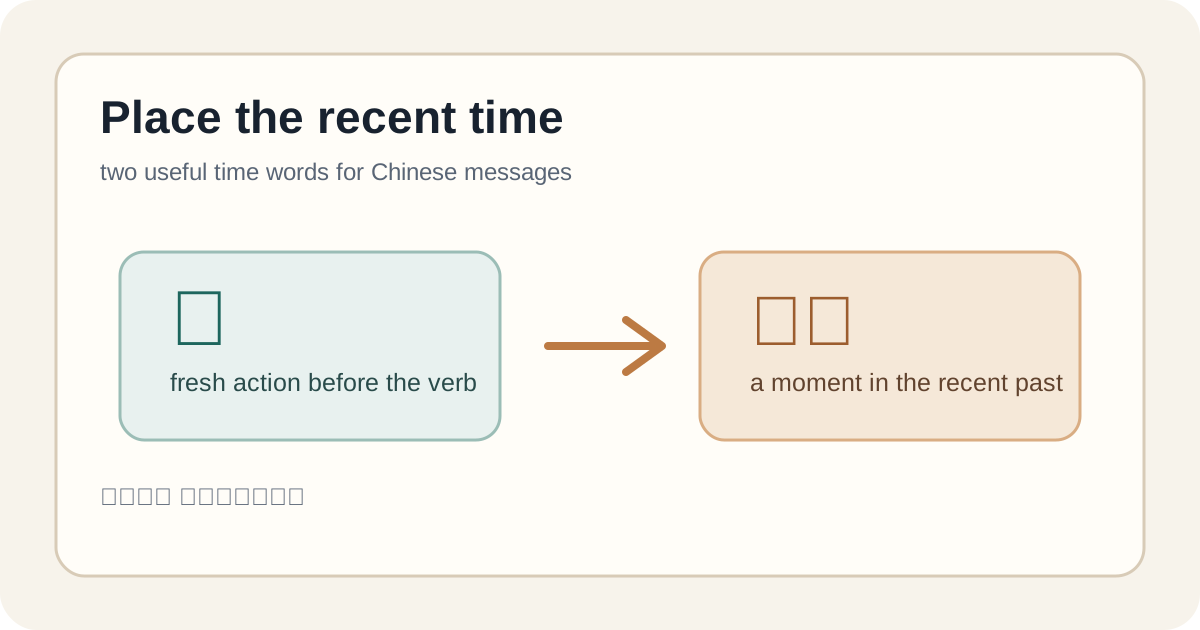
Use 刚 (gāng) when you want to say that an action happened very recently, often immediately before the verb. Use 刚才 (gāngcái) when you want to point to a moment a short time ago. In a message, 刚 usually describes the action itself, while 刚才 gives the time reference.
Compare these messages:
我刚到。(I just arrived.)我刚才看到你的消息。(I saw your message a moment ago.)你刚才说什么?(What did you just say?)
Both words refer to recent time, so the choice can feel small. Their position makes the difference easier to see. Type the complete sentence with your Pinyin input method, choose the Hanzi candidate, and reread whether you are describing a fresh action or pointing back to an earlier moment.
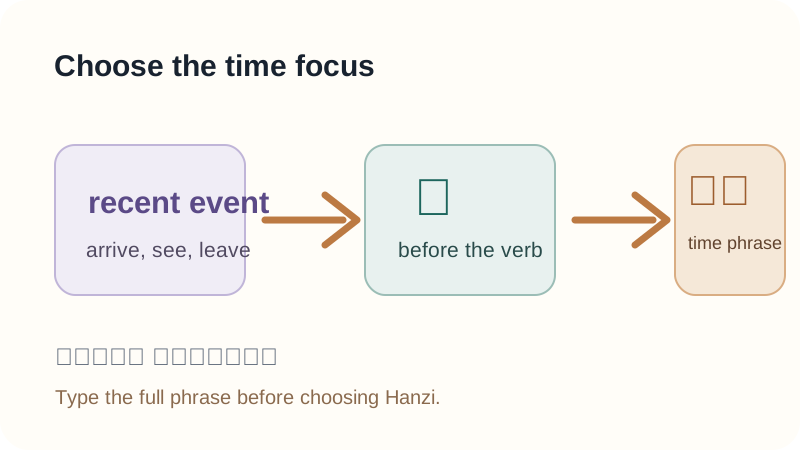
Start with the time reference, then place 刚 or 刚才 where the sentence needs it.
The short answer: 刚 sits close to the action
| Message job | Useful pattern | Example | Meaning |
|---|---|---|---|
| Report a fresh action | Subject + 刚 + verb | 我刚下班。 | I just finished work. |
| Report a recent arrival | Subject + 刚 + verb | 他刚到家。 | He just got home. |
| Point to a recent moment | 刚才 + subject + verb | 刚才你在找我吗? | Were you looking for me just now? |
| Ask about an earlier line | Subject + 刚才 + verb | 你刚才说什么? | What did you say just now? |
These are useful defaults for HSK 2 to 4 messages. Context decides how recent the event feels. If the time matters, add a clearer expression such as 五分钟前 (five minutes ago) or write the clock time.
Use 刚 before a recent action
Put 刚 before the verb or verb phrase that happened a short time ago:
我刚吃完饭。(I just finished eating.)她刚下班。(She just finished work.)手机刚响。(The phone just rang.)我刚看到你的消息。(I just saw your message.)
The word keeps the focus on the new action. In 我刚看到你的消息, the useful information is that seeing the message happened moments ago. This works well as a reply when someone is waiting for an answer:
不好意思,我刚看到消息。(Sorry, I just saw the message.)我刚到家,现在可以说话。(I just got home. I can talk now.)他刚走,你可以晚一点再来。(He just left. You can come later.)
刚 can also appear before a verb phrase that includes a result, such as 刚开始 (just started) or 刚结束 (just ended). Keep the phrase together while you type so the candidate window has more context.
Use 刚才 to point back to a recent moment
刚才 acts like a time phrase. It can appear at the start of a sentence, after the subject, or before the verb:
刚才谁打电话了?(Who called just now?)我刚才在开会。(I was in a meeting just now.)你刚才说几点?(What time did you say just now?)我刚才没听清。(I did not hear clearly a moment ago.)
Use it when the reader needs to locate the event in the recent conversation:
你刚才发的文件打不开。(The file you sent just now will not open.)我刚才看到一个问题,想再确认一下。(I saw a problem just now and want to check it again.)刚才的会议几点结束?(What time did the meeting just now finish?)
The time phrase can modify a noun as in 刚才的消息 (the message from just now). That is another clue that 刚才 names a time, while 刚 usually stays close to the action.
Compare 刚, 刚才, 刚刚, 以前, and 以后
These time words are easy to mix up when you translate each one as "just" or "before":
| Word | Main job | Example | Time relationship |
|---|---|---|---|
| 刚 | Mark a fresh action | 我刚到家。 | The action is very recent. |
| 刚才 | Name a recent moment | 我刚才到家了。 | The event happened a moment ago. |
| 刚刚 | Conversational form close to 刚 | 我刚刚看到。 | The action happened very recently. |
| 以前 | Point to an earlier period | 我以前住这里。 | Before now or before another time. |
| 以后 | Point to a later period | 以后再说。 | After now or after another event. |
刚刚 often works like 刚 in everyday speech and chat. You can learn it as a close variation, then focus on keeping 刚才 in the time phrase position. The 以前 and 以后 guide has more examples for a wider past or future period.
Put the difference into real messages
These examples fit study chats, work messages, and everyday plans:
我刚下课,十分钟后到。(I just finished class. I will arrive in ten minutes.)你刚才给我打电话了吗?(Did you just call me?)我刚才发错了,马上重发。(I sent the wrong thing just now. I will resend it right away.)他刚开始学中文。(He just started learning Chinese.)刚才的地址有一个字错了。(One character in the address from just now was wrong.)
When someone is waiting for a reply, 我刚看到 explains the current delay. When you are correcting a specific earlier message, 我刚才发错了 points back to that message. Both are natural; the sentence focus changes.
Punctuation helps separate the time reference from the update:
我刚才看到你的消息,现在回复你。
The comma shows that the first clause gives the recent event and the second clause gives the current response. The Chinese punctuation typing guide covers similar short messages with two connected clauses.
A Pinyin routine for 刚 and 刚才
The Ministry of Education overview of Hanyu Pinyin describes Pinyin as a tool used in learning and communication. For daily typing, the keyboard controls vary by platform, but the review routine stays the same:
- Decide whether you are describing a fresh action or pointing to a recent moment.
- Type the whole phrase, such as
wo gang daoorwo gangcai kan dao. - Choose
刚or刚才from the candidate list. - Check the verb and any time phrase that follows.
- Read the full message again before sending.
Typing gang by itself may show 刚, 钢, 港, or other candidates. Typing gangcai gives the input method the complete syllable sequence. Apple's Chinese input method guide explains that its candidate window displays possible characters for an input code and lets you select the intended one.
If your input method chooses a different character, the wrong-character troubleshooting guide gives a longer review routine. The Mandarin sentence typing guide explains why complete sentence input is more useful than memorizing isolated candidates.
A five-minute typing drill
Read the meaning, type the Chinese from memory, and explain whether the sentence describes a fresh action or points to a recent moment:
| Meaning | Target sentence | Pinyin input | Check |
|---|---|---|---|
| I just arrived. | 我刚到了。 | wo gang dao le | fresh action |
| I just saw your message. | 我刚看到你的消息。 | wo gang kandao nide xiaoxi | fresh action |
| Who called just now? | 刚才谁打电话了? | gangcai shui da dianhua le | recent moment |
| What did you say just now? | 你刚才说什么? | ni gangcai shuo shenme | recent conversation |
| I was in a meeting just now. | 我刚才在开会。 | wo gangcai zai kaihui | recent situation |
| I just finished class. | 我刚下课。 | wo gang xia ke | fresh action |
On a second pass, change one detail in each line. Turn 我刚到了 into 我刚到家了. Turn 你刚才说什么 into 你刚才说几点. Keep the time word in place while you change the verb or object.
The real-message typing drills add more prompts for replies, requests, and short updates.
Mistakes to catch before sending
Putting 刚才 in front of every verb
我刚才看到你的消息 is clear when you are pointing to a moment in the recent past. 我刚看到你的消息 keeps the focus on the fresh action and often fits a reply about why you answered late. Choose based on the message job.
Treating 刚 as a time noun
刚 normally stays close to the verb: 我刚下班. Use 刚才 when you need a time phrase such as 刚才的消息 or 刚才谁来了.
Choosing a candidate from gang alone
gang has several possible Hanzi candidates. Type the surrounding words, select the full phrase, and check whether the sentence says 刚, 刚刚, or another word.
Using a recent word for an old event
刚才 points to a recent moment whose exact length depends on the conversation. For yesterday, last week, or an earlier life period, use a clearer time expression. The 了, 过, and 着 guide covers other ways to place an action in time.
Forgetting the result of the action
我刚发 may be enough in a quick chat, but 我刚发错了 tells the reader that the send action had a problem. Add the result or next step when the reader needs it.
FAQ
What is the difference between 刚 and 刚才?
刚 usually appears before a verb to describe an action that happened very recently. 刚才 is a time phrase that points to a moment a short time ago. Compare 我刚到家 with 我刚才在路上.
Can 刚才 go at the beginning of a sentence?
Yes. 刚才谁给你打电话? starts with the time reference. You can also put it after the subject, as in 你刚才说什么?.
Does 刚 always need 了?
No. 我刚到 and 我刚到家 are complete in the right context. Add 了 when the sentence needs to mark a completed event or a change, as in 我刚到了.
Is 刚刚 the same as 刚?
刚刚 often has the same recent-action meaning as 刚 in everyday messages. Start with 刚 for a simple pattern, then recognize 刚刚 when you see it in a chat.
How do I type 刚 and 刚才 with Pinyin?
Type gang for 刚 and gangcai for 刚才, then select the intended candidates. Adding the surrounding words reduces ambiguity.
Can I use 刚才 in a question?
Yes. Questions such as 你刚才去哪儿? and 你刚才说什么? ask the reader to identify something from a recent moment.
How recent is 刚才?
It refers to a moment the speakers can identify as recent. The exact period depends on context and conversation. If the timing could be misunderstood, write 五分钟前, 刚才十点, or another specific expression.
Limits of this shortcut
These patterns cover common HSK 2 to 4 messages. Recent time words depend on the conversation, and a message can sound vague if the reader does not know which event you mean. For a work update, travel plan, or correction that needs a firm record, add the clock time or a concrete duration.
Use this guide to choose the time word, then type and reread the complete sentence. The goal is a message that tells the reader both what happened and where it sits in the conversation.