How to Type 别 and 不要 in Chinese Messages
MandarinReps
10/23/2026
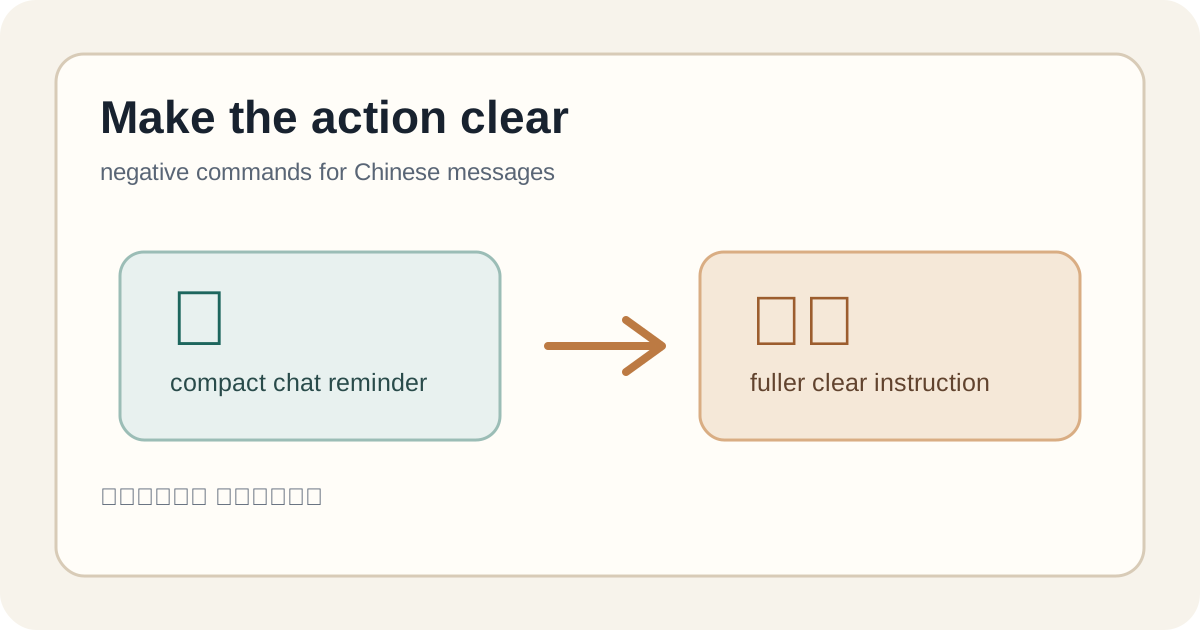
Use 别 (bié) or 不要 (bú yào) before a verb when you want to tell someone not to do something. 别 is the shorter form that fits many quick spoken and chat messages. 不要 is the fuller form, useful when the instruction needs to be explicit or when you want to add a polite marker such as 请.
Compare these everyday messages:
别担心。(Do not worry.)不要忘了发地址。(Do not forget to send the address.)请不要在这里拍照。(Please do not take photos here.)
Both 别 and 不要 can introduce a negative command. The choice depends on the length, context, and clarity you need. Type the whole phrase instead of choosing a Hanzi candidate from one syllable at a time, then check the verb and punctuation before sending.
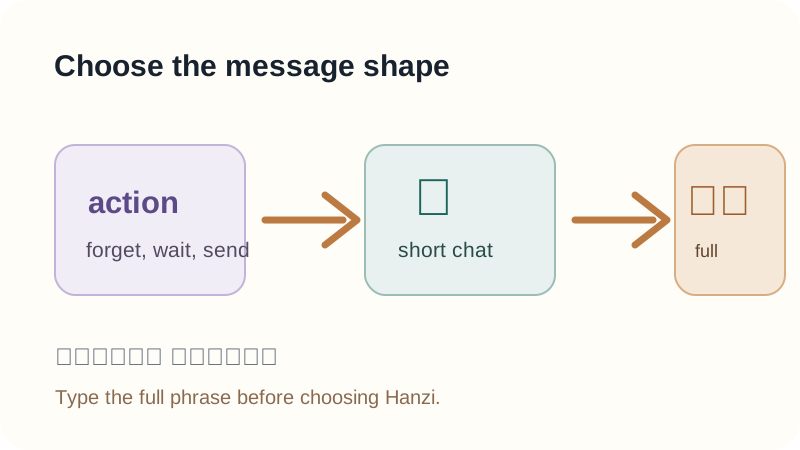
Choose the short or full negative-command pattern after you decide what the reader must not do.
The short answer: 别 is compact, 不要 is fuller
Start with the action you want to stop. Put 别 or 不要 before that verb:
| Message job | Pattern | Example | Meaning |
|---|---|---|---|
| Give a short warning | 别 + verb | 别走。 | Do not leave. |
| Give a short reminder | 别 + verb | 别忘了回复。 | Do not forget to reply. |
| State a full instruction | 不要 + verb | 不要把文件发错。 | Do not send the file to the wrong place. |
| Make a public or written instruction clear | 请不要 + verb | 请不要在这里拍照。 | Please do not take photos here. |
Neither is automatically polite or harsh: 别担心 can sound warm, while 不要说英文! can sound firm. Context matters.
Use 别 for a short warning or request
别 often works well when the listener already knows the situation and the message can stay short:
别走。(Do not leave.)别着急。(Do not worry or hurry.)别忘了回复。(Do not forget to reply.)别在这里打电话。(Do not make phone calls here.)
The subject is often left out because the recipient is clear from the chat. If the message is for several people or could be forwarded, add the subject or context:
大家别忘了带身份证。(Everyone, do not forget to bring your ID.)你别先发文件,等我确认。(Do not send the file yet; wait for me to confirm.)
The pattern 别再 + verb adds the idea of stopping a repeated action:
别再发错地址了。(Stop sending the wrong address.)别再问同一个问题了。(Do not ask the same question again.)
Use this pattern only when the repeated action is part of the meaning. If you simply want to prevent one future action, 别 + verb is enough.
Use 不要 for a complete instruction
不要 is useful when you want the prohibition to be easy to identify in a longer message:
不要忘记带护照。(Do not forget to bring your passport.)不要把这个链接发给别人。(Do not send this link to other people.)不要在会议中打电话。(Do not make phone calls during the meeting.)
Add 请 when the situation calls for a polite written request:
请不要回复这个号码。(Please do not reply to this number.)请不要把照片发到公开群。(Please do not send the photo to a public group.)
不要 does not automatically make a sentence polite. A sentence such as 不要说英文! is still a strong instruction because the verb and exclamation mark make it direct. If the relationship matters, add a reason or a softer request:
可以先不要发吗?我想再看一遍。(Could you wait before sending it? I want to read it once more.)
Compare common message patterns
| Pattern | Example | Best use in a message |
|---|---|---|
| 别 + verb | 别忘了回复。 | A compact reminder |
| 不要 + verb | 不要忘记回复。 | A complete, explicit instruction |
| 别再 + verb | 别再发错了。 | Stop a repeated problem |
| 请不要 + verb | 请不要转发。 | A polite written request |
| 不要...了 | 不要说了。 | Stop an action that is happening or being discussed |
The last pattern needs context. 不要说了 can mean "stop talking" or "do not say it anymore," depending on the conversation. Do not treat 不要...了 as a universal replacement for every sentence with 别.
Also keep negative commands separate from ordinary negation. 不 usually describes a fact, preference, or future decision:
我不喝咖啡。(I do not drink coffee.)我今天不去。(I am not going today.)
别喝咖啡。 is directed at another person: "Do not drink coffee." For more practice distinguishing 不 and 没 in messages, read the 不 and 没 typing guide.
别 and 不要 in digital messages
This grammar appears in work chats, study groups, travel plans, and family messages:
别忘了把会议时间发给我。(Do not forget to send me the meeting time.)不要把旧文件上传到新文件夹。(Do not upload the old file to the new folder.)大家别在这里等,入口在另一边。(Everyone, do not wait here; the entrance is on the other side.)请不要把验证码发给任何人。(Please do not send the verification code to anyone.)你别着急,我马上回电话。(Do not worry; I will call back soon.)
In a short personal chat, 别 can keep a reminder compact. In a notice or work instruction, 不要 often makes the action easier to identify.
Make the object specific when a vague verb could cause confusion:
- Less clear:
不要发。(Do not send it.) - Clearer:
不要把合同发到群里。(Do not send the contract to the group.)
If the recipient already knows the object, the shorter form is natural. If the message may be forwarded, write the object and destination.
Punctuation that makes a prohibition easier to scan
Use the Chinese comma , when a reason or second instruction follows:
请不要现在发,文件还没有检查完。别着急,我马上回复。不要打开这个链接,先问一下管理员。
Use 。 for a straightforward statement and ? when you are asking for agreement:
请不要转发。(Please do not forward it.)我们可以先不要发吗?(Can we wait before sending it?)
The Chinese punctuation typing guide has more practice with fullwidth commas, periods, and question marks. Type the entire message, then decide where the pause or sentence ending helps the reader.
A Pinyin candidate routine
The Ministry of Education Hanyu Pinyin scheme is a reference for the Romanization system. On a keyboard, type bie for 别 and bu yao for 不要 without tone marks. Then include the verb before choosing a candidate:
- Decide the action: forget, wait, send, call, or worry.
- Type the complete phrase, such as
bie wangji huifuorbu yao wangji fa xiaoxi. - Choose
别or不要from the candidate window. - Type the object and destination if the action could be unclear.
- Read the Hanzi sentence aloud and check whether it is a command or an ordinary statement.
Apple's guide to using the Chinese candidate window on Mac explains how to select characters from the candidate list. The two-character input bu yao is easier to verify inside a phrase than in isolation. The Chinese Tests Service HSK syllabus gives a broader study framework; these drills keep the goal at complete messages for HSK 2 to 4 learners.
A five-minute typing drill
Read the English meaning first. Type the Pinyin, select the Hanzi, and check the action that follows the negative command.
| Meaning | Target sentence | Pinyin input | Check |
|---|---|---|---|
| Do not leave. | 别走。 | bie zou | short action: 走 |
| Do not worry. | 别担心。 | bie danxin | common short phrase |
| Do not forget to reply. | 别忘了回复。 | bie wang le huifu | reminder: 忘了 |
| Do not send the file to the group. | 不要把文件发到群里。 | bu yao ba wenjian fa dao qun li | object and destination |
| Please do not take photos here. | 请不要在这里拍照。 | qing bu yao zai zheli paizhao | polite written request |
| Everyone, do not wait here. | 大家别在这里等。 | dajia bie zai zheli deng | subject: 大家 |
Repeat the drill with one controlled change:
别忘了回复。->不要忘记回复。不要把文件发到群里。->不要把文件发给我。请不要在这里拍照。->请不要在会议室拍照。
For more real-situation prompts, use the Chinese typing practice drills and the Mandarin sentence typing guide.
Mistakes to catch before sending
Using 不 for a command
我不发。 means "I will not send it" or "I do not send it." It does not directly tell another person what to do. Use 别发。 or 不要发。 when the message is a prohibition.
Forgetting the action
不要 and 别 normally need a verb or verb phrase after them: 别走, 不要打开, or 请不要转发. If the listener might ask "do not do what?", add the action.
Choosing 别 from the wrong phrase
When you type bie, check the sentence. In 别担心, the target is 别. In 别的文件, 别的 means "other" and is not a negative command. Candidate context matters.
Treating tone as a fixed grammar rule
别 is not always rude, and 不要 is not always polite. Compare the friendly 别担心 with the forceful 不要说英文!. Use context, a reason, 请, or a question when you need to manage the tone.
Leaving the object too vague
不要发 may be enough in a live conversation. In a work or group chat, 不要把合同发到群里 protects the reader from guessing what to avoid.
Sending before checking the punctuation
别着急,我马上回复。 and 别着急!我马上回复。 have different rhythm. Reread the message after selecting Hanzi and check whether the second clause explains, reassures, or stands alone.
Limits of this shortcut
These patterns cover common HSK 2 to 4 messages for warnings, reminders, requests, and instructions. They do not describe every use of 别, 不要, or the particle 了. A teacher, manager, public notice, or close friend may choose a different sentence because the relationship and consequences are different.
When the message matters, write the action, object, destination, and reason first. Then choose the shorter 别 pattern or the fuller 不要 pattern, add 请 if appropriate, and read the final Hanzi before sending.
FAQ
Are 别 and 不要 the same?
They can both introduce a negative command, so they overlap in many sentences. 别 is shorter and often fits a quick message. 不要 is the fuller form and can make a written instruction easier to identify. Context decides the final tone.
Is 别 more rude than 不要?
Not automatically. 别担心 can sound reassuring, while 不要说英文! can sound strong. The verb, punctuation, relationship, and situation matter more than the first word alone.
How do I type 别 in Pinyin?
Type bie and choose 别 from the candidate window. Use a complete phrase such as bie wangji huifu when several candidates appear.
How do I type 不要 in Pinyin?
Type bu yao and choose 不要. A full phrase such as bu yao wangji fa xiaoxi gives you more context than typing one syllable at a time.
Can I say 请别?
Yes, 请别 can be used in some requests, especially when the sentence is short, such as 请别担心. For a clear written instruction, 请不要 + verb is also a useful pattern. Choose the form that fits the relationship and context.
What is the difference between 别再 and 不要再?
Both can tell someone to stop repeating an action: 别再发错了 and 不要再发错了. 别再 is more compact. Keep 再 only when repetition or continuation is part of the intended meaning.
Why is 别 also used in 别的?
别 in 别的 means "other" and is not the negative-command word in 别走. Read the following word and the whole sentence before choosing a translation.